NIA Full Form stands for National Investigation Agency. It is India’s premier central counter-terrorism law enforcement body, operating under the Ministry of Home Affairs. The NIA Full Form represents an agency that was created by Parliament through the National Investigation Agency Act, 2008, directly in response to the 26/11 Mumbai terror attacks, to investigate terrorism and other national security-related offences across India.
Why India Created NIA After 26/11
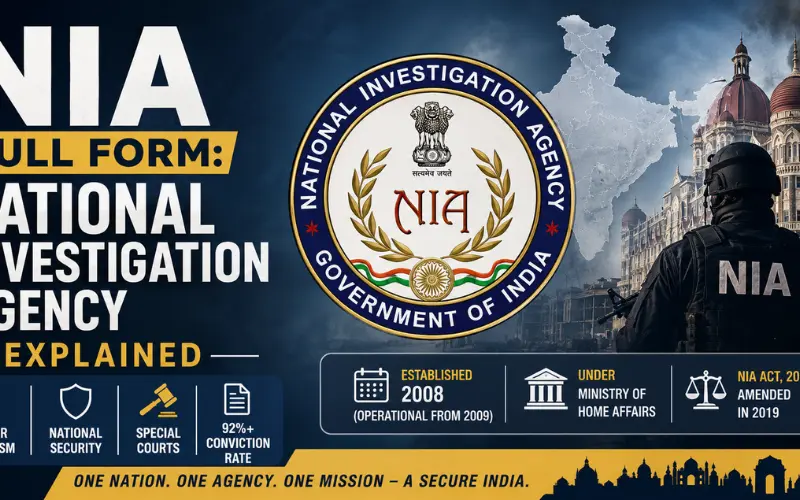
On the night of November 26, 2008, ten Pakistani terrorists coordinated simultaneous strikes across Mumbai, killing 166 people. The investigation exposed a brutal gap:
no single Indian agency could cross state boundaries to chase terror networks. State police had jurisdiction only within their own state. The CBI needed state government permission before entering a case.
NIA was Parliament’s answer to that gap. The NIA Act was passed just five weeks after the attacks, on December 31, 2008. The agency officially began operations in 2009.
That origin story matters because it explains exactly what NIA does and why it has powers no other Indian investigative body holds.
What Makes NIA Different from Every Other Agency
NIA is the only investigative agency in India that does not need state government permission to investigate a case. This is called concurrent jurisdiction, and it is the core legal power that sets NIA apart.
Here is how it works in practice:
- A terror attack happens in, say, Tamil Nadu.
- The state police begin their investigation.
- NIA can step in, take over the case, and continue investigating across any state in India, without asking Tamil Nadu for consent.
- NIA officers have all the powers of a police officer across the entire country.
The CBI, by contrast, must get a state’s “general consent” or specific permission before it can operate there. Several states have withdrawn that consent from the CBI at different points. NIA has no such limitation.
NIA Full Form: Quick Reference
| Attribute | Detail |
| Full Form | National Investigation Agency |
| Established | 2008 (operational from 2009) |
| Parent Ministry | Ministry of Home Affairs, Government of India |
| Headquarters | Opposite CGO Complex, Lodhi Road, New Delhi – 110003 |
| Head | Director General (DG), IPS rank officer |
| Conviction Rate | Over 92% (one of the highest among Indian agencies) |
| Governing Law | NIA Act, 2008 (amended 2019) |
What NIA Actually Investigates
The NIA Act includes a “Schedule” of offences the agency can probe. The original 2008 list covered:
- Terrorism under the Unlawful Activities (Prevention) Act (UAPA)
- Bombings and explosive devices
- Attacks on nuclear installations
- Hijacking of aircraft and ships
- Offences against foreign dignitaries
The 2019 amendment significantly widened this list. NIA can now also investigate:
- Cyberterrorism
- Human trafficking linked to terror financing
- Counterfeit currency operations funding terrorism
- Smuggling of arms and drugs with a national security angle
This expansion made NIA relevant to modern threat vectors that the 2008 Act simply could not have anticipated.
The NIA Amendment Act 2019: What Changed

The National Investigation Agency (Amendment) Act, 2019 passed both houses of Parliament unanimously. Beyond adding new offences to the schedule, it made two other significant changes:
Extraterritorial jurisdiction. NIA can now investigate offences committed outside India if they affect Indian nationals or Indian interests. This was not possible under the original act.
Faster trials. The amendment strengthened the role of designated NIA Special Courts and streamlined the process for designating new ones, reducing the lag between charge-sheet filing and trial.
NIA Special Courts: How Trials Work
NIA does not go to ordinary sessions courts after filing a charge-sheet. The central government designates specific NIA Special Courts across states exclusively for NIA cases. Each state has at least one.
The purpose is speed and specialization. Judges in these courts handle only NIA-related matters, which means they build familiarity with counter-terrorism law, UAPA provisions, and evidentiary standards specific to these cases.
The result shows in the numbers. As of 2025, NIA has secured a conviction rate of over 92%, one of the highest of any investigative or prosecutorial agency in India. In one parliamentary reply, the government confirmed 100 out of 103 completed trials ended in conviction.
That figure is not just a statistic. It reflects rigorous case-building from investigation to charge-sheet to court, which is the agency’s stated operating model.
NIA vs. CBI: The Practical Difference
Both agencies investigate serious crimes, but their mandates and operational limits are very different.
Jurisdiction: CBI needs state consent. NIA does not.
Scope: CBI handles corruption, economic offences, and major crimes broadly. NIA handles only national security and terror-linked offences listed in its Schedule.
Precedence: When NIA takes over a state police investigation, the state police hand over all documents, evidence, and arrested persons immediately. NIA’s jurisdiction overrides, not supplements.
Political independence on entry: NIA can register a case suo motu (on its own initiative) without waiting for a reference from a state government. CBI cannot do this.
In short: NIA is narrower in scope but wider and more independent in reach.
NIA Regional Offices and Headquarters
NIA operates from its main headquarters at Opposite CGO Complex, Lodhi Road, New Delhi-110003.
It also runs divisional and branch offices across India to handle investigations in major regions without requiring every team to operate out of New Delhi. Key branch offices include locations in Hyderabad, Kochi, Mumbai, Lucknow, Kolkata, Guwahati, Jammu, Chandigarh, and Raipur, among others.
For reporting tip-offs or information on terrorist activity, NIA maintains a public WhatsApp number: 8585931100.
Other Meanings of NIA
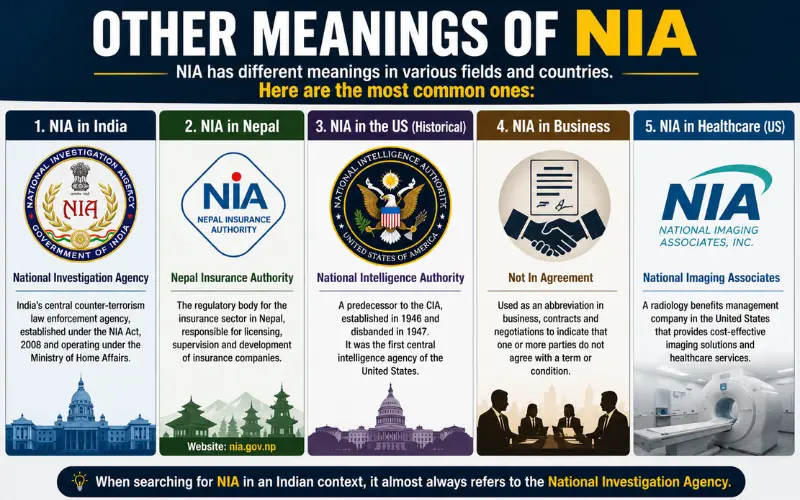
“NIA” is an acronym used in more than one context. If you are outside India or searching in a different domain, be aware of these:
- Nepal Insurance Authority (NIA): The regulatory body for the insurance sector in Nepal, accessible at nia.gov.np.
- NIA in the US: The National Intelligence Authority, a predecessor to the CIA (historical, 1946-1947).
- NIA in business contexts: Sometimes used as shorthand for “Not In Agreement” in contract and negotiation documents.
- NIA in healthcare: Can refer to the National Imaging Associates, a radiology benefits management company in the United States.
When searching for NIA in an Indian context, the result is always the National Investigation Agency.
FAQ: NIA Full Form and Common Questions
What is the full form of NIA in India?
NIA stands for National Investigation Agency. It is India’s central counter-terrorism and national security investigation agency, established under the NIA Act, 2008, and operating under the Ministry of Home Affairs.
When was NIA formed and why?
NIA was established through an Act of Parliament passed on December 31, 2008, following the 26/11 Mumbai terror attacks. The attacks exposed the need for a federal agency that could investigate cross-state terror networks without requiring permission from individual state governments.
Does NIA need state government permission to investigate?
No. Unlike the CBI, NIA has concurrent jurisdiction across all Indian states. It can register cases and take over investigations from state police without seeking consent from any state government.
What is the conviction rate of NIA?
As of 2025, NIA has a conviction rate exceeding 92%, making it one of the highest-performing agencies in India in terms of successful prosecutions.
What new powers did NIA get after the 2019 amendment?
The NIA Amendment Act 2019 expanded its mandate to cover cyberterrorism, human trafficking with a terror-financing angle, counterfeit currency operations, and arms smuggling tied to national security. It also gave NIA the power to investigate offences committed outside India that affect Indian nationals or interests.
How is NIA different from RAW and IB?
NIA is an investigative agency that builds cases, arrests suspects, and prosecutes in court. RAW (Research and Analysis Wing) is India’s external intelligence agency and does not investigate or arrest within India. IB (Intelligence Bureau) is the internal intelligence body focused on gathering information, not prosecution. NIA is the only one of the three that operates as a law enforcement body with arrest powers.
Where is NIA headquarters located?
NIA’s headquarters is at Opposite CGO Complex, Lodhi Road, New Delhi-110003. You can contact the agency at [email protected] or via WhatsApp at 8585931100.
What kinds of cases does NIA handle?
NIA handles terrorism, bomb blasts, attacks on nuclear and strategic installations, hijacking, offences against foreign dignitaries, human trafficking linked to terror, cyberterrorism, and smuggling of arms and drugs with a national security nexus.
Final Thought
NIA Full Form is much more than just an abbreviation—it represents the National Investigation Agency, India’s premier counter-terrorism and national security investigation agency. Created in the aftermath of the 26/11 Mumbai attacks, the NIA was established to ensure that terror-related investigations can be carried out swiftly, professionally, and across state boundaries without legal hurdles.
Over the years, its jurisdiction has expanded to tackle emerging threats such as cyberterrorism, terror financing, and transnational crimes, making it one of the country’s most important law enforcement institutions. Whether you’re preparing for UPSC, SSC, defence exams, or simply want to understand India’s security framework, knowing the NIA Full Form, its history, powers, and role provides valuable insight into how the nation combats terrorism and protects its citizens.
You May Also Like It:
IB Full Form: Intelligence Bureau India, Meaning, History & Career Guide
CDS Full Form: Everything You Need to Know About Combined Defence Services & 15 Must-Know Facts
SSC Full Form(2026): What It Means, Why It Matters for Your Career, and Everything You Need to Know