RAW Full Form stands for Research and Analysis Wing. It is India’s primary foreign intelligence agency, responsible for collecting, processing, and acting on intelligence gathered outside India’s borders. Established on September 21, 1968, RAW Full Form is widely associated with India’s external intelligence operations. The agency operates under the Cabinet Secretariat and reports directly to the Prime Minister.
Why India Created RAW in 1968
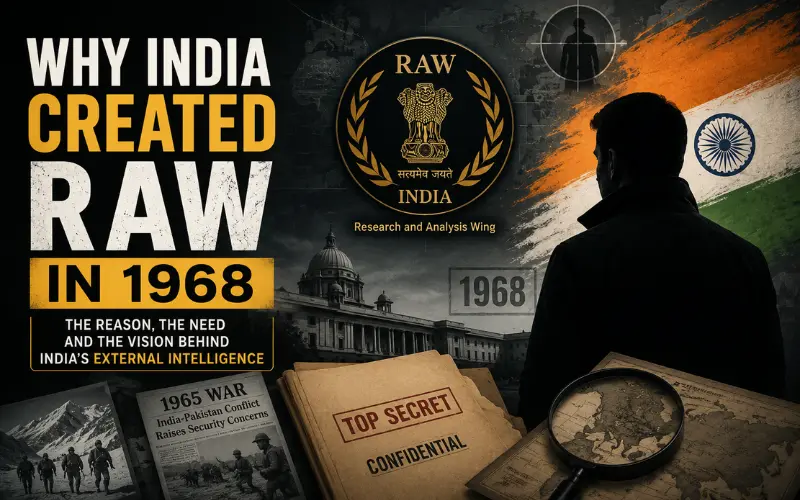
Before RAW existed, India’s domestic intelligence bureau (the Intelligence Bureau, or IB) handled both internal and external intelligence. That was a structural flaw.
The 1962 Sino-Indian War and the 1965 India-Pakistan War exposed serious gaps. Indias military was repeatedly caught off guard by enemy movements that better foreign intelligence could have flagged. The IB, primarily designed to watch internal threats, was stretched far beyond its competence.
Prime Minister Indira Gandhi recognized the problem. She tasked Rameshwar Nath Kao, a senior IB officer, with building a dedicated external intelligence agency from scratch.
RAW was formally created on 21 September 1968. Kao became its first chief and is often called the father of Indian intelligence.
RAW Core Mandate: What It Actually Does
RAW’s official mandate covers four broad areas:
- Foreign intelligence gathering: Monitoring political, military, and economic developments in countries of strategic interest, especially Pakistan, China, and neighboring nations.
- Counter-terrorism: Tracking and disrupting foreign-backed militant networks that threaten Indian citizens or territory.
- Counter-proliferation: Preventing the spread of weapons of mass destruction across South Asia.
- Influence operations: Supporting India’s strategic interests through non-military means, including covert diplomacy and psychological operations.
RAW also works closely with India’s signals intelligence arm (NTRO) and military intelligence. It is not a law enforcement agency. RAW officers cannot arrest people inside India. That is the IB’s domain.
RAW vs. Other Major Intelligence Agencies
| Feature | RAW (India) | CIA (USA) | MI6 (UK) | ISI (Pakistan) |
| Focus | External intelligence | Foreign intelligence | Foreign intelligence | Both internal & external |
| Founded | 1968 | 1947 | 1909 | 1948 |
| Statutory basis | None (executive order) | Yes (National Security Act) | Yes (Intelligence Services Act) | Yes |
| Reports to | Prime Minister | President (via DNI) | Foreign Secretary | Army Chief (de facto) |
| Budget | Classified | Classified (est. ~$15B for IC) | Classified | Classified |
| Field agents | Yes (HUMINT) | Yes | Yes | Yes |
| Oversight | Cabinet Secretariat only | Congress committees | Parliamentary committees | Limited |
One thing that surprises people: RAW has no constitutional or statutory status. Unlike the CIA, which was created by an Act of Congress, RAW was established through an executive order. There is no dedicated law governing its operations, no formal legislative oversight, and no public accountability mechanism. This gives it operational flexibility but also makes it one of the world’s least legally constrained major agencies.
RAW Most Significant Operations (Publicly Known)
Specifics are scarce because RAW rarely acknowledges operations. But a few are well-documented:
The 1971 Bangladesh Liberation War.
RAW’s most celebrated operation. The agency played a central role in training and supporting the Mukti Bahini (Bengali guerrilla forces) fighting Pakistani rule.
Intelligence from RAW gave the Indian military a significant strategic advantage.
Bangladesh became an independent nation in December 1971, and RAW’s covert groundwork is widely credited as a decisive factor.
Operation Smiling Buddha preparation (1974).
RAW helped secure nuclear materials and intelligence before India’s first nuclear test, ensuring the operation remained secret from foreign surveillance.
Counter-insurgency in Punjab (1980s-90s).
RAW worked alongside domestic agencies to counter Khalistan separatist networks that had external support.
Sri Lanka and the LTTE period.
RAW’s involvement in Sri Lanka during the 1980s is complex and debated. It initially assisted Tamil militant groups, then shifted strategy as the situation changed. A cautionary example of intelligence policy getting ahead of political strategy.
The Structure No One Explains Clearly
RAW’s head carries the title Secretary (Research) in the Cabinet Secretariat. This deliberate obscurity keeps the agency out of public-facing government directories.
The agency is believed to be organized into divisions covering:
- Regional divisions (China, Pakistan, South Asia, Middle East, etc.)
- Technical intelligence (signals, cyber, satellite)
- Counter-terrorism
- Aviation Research Centre (ARC): RAW’s technical intelligence arm, which operates reconnaissance aircraft and satellite surveillance
- Special Frontier Force (SFF): A paramilitary unit operating under RAW’s umbrella, primarily composed of Tibetan volunteers
The SFF saw action as recently as 2020 during the Galwan Valley standoff with China along the Line of Actual Control.
Common Misconceptions About RAW

RAW is like India’s police.
No. RAW has zero domestic law enforcement powers. It cannot arrest, detain, or prosecute anyone inside India.
RAW operates secretly inside India.
The IB (Intelligence Bureau) handles domestic intelligence. RAW is legally restricted to external operations.
RAW’s budget is huge and public.
The budget is buried inside the Union Budget under non-descript allocations and has never been publicly declared.
RAW answers to the Defence Ministry.
It does not. RAW reports directly to the Prime Minister’s Office through the Cabinet Secretariat, bypassing the Defence and Home Ministries entirely.
Frequently Asked Questions(FAQ)
What is the full form of RAW in Hindi?
In Hindi, RAW is referred to as “अनुसंधान और विश्लेषण विंग” (Anusandhan aur Vishleshan Wing). The acronym RAW is universally used across languages in India.
Who is the current chief of RAW?
The head of RAW holds the title of Secretary (Research) in the Cabinet Secretariat. The government rarely makes formal public announcements about appointments. As of 2025, Ravi Sinha serves as the chief. Check current news sources for the latest, as leadership changes without much fanfare.
Is RAW more powerful than the IB?
They serve different purposes, so a direct power comparison doesn’t quite work. RAW focuses on foreign threats; IB focuses on domestic security. RAW operates abroad with a broader mandate and is believed to have a larger field network. However, the IB has domestic reach that RAW does not.
Can Indian citizens join RAW directly?
Not through a public job posting. RAW recruits primarily through lateral entry from the Indian Police Service (IPS), Indian Foreign Service (IFS), Indian Army, and occasionally through the Civil Services. There is no direct “apply to RAW” process for fresh graduates.
Final Thought
RAW Full Form is much more than just the abbreviation for Research and Analysis Wing. It represents India’s first line of defence against external threats, providing intelligence that helps shape national security, foreign policy, and strategic decision-making.
Although much of its work remains classified, RAW has played a vital role in protecting the country’s interests since its establishment in 1968. Understanding its history, responsibilities, and structure gives you a clearer picture of how modern intelligence agencies operate behind the scenes.
Whether you are preparing for competitive exams, expanding your general knowledge, or simply curious about India’s intelligence system, knowing the RAW Full Form and its significance offers valuable insight into one of the nation’s most important institutions.
You May Also Like It:
SST Full Form in English and Hindi