BSF Full Form is one of the most searched queries among students, defence aspirants, and general knowledge enthusiasts in India. If you have seen the term BSF in the news, especially around border incidents or Republic Day parades, you have probably wondered what it actually stands for. It is one of India’s most recognised uniformed forces, yet most people only know it by its abbreviation.
The BSF full form is Border Security Force. In this and our other informative blogs, you’ll learn that it is the primary force guarding India’s international borders with Pakistan and Bangladesh, and it plays a much bigger role in national security than most people realise.
This guide explains what BSF means, how it came to be, what its personnel actually do, and details that most articles on this topic leave out.
Quick Answer: BSF Full Form
| Term | Meaning |
|---|---|
| BSF | Border Security Force |
| BSF in Hindi | सीमा सुरक्षा बल (Seema Suraksha Bal) |
| Formed on | 1 December 1965 |
| Governing law | Border Security Force Act, 1968 |
| Ministry | Ministry of Home Affairs |
| Motto | “Duty Unto Death” |
The BSF is one of India’s five Central Armed Police Forces, sitting alongside forces like the CRPF and CISF, but with a mandate that is unique to it: guarding the country’s land borders during peacetime and supporting the Army during war.
How the BSF Came to Be

The BSF was not born out of routine planning. It was created as a direct response to a security failure.
BSF full form is closely linked to India’s modern border security system. Before 1965, India’s borders were guarded by individual state police forces rather than a single unified command. During the 1965 Indo-Pak War, this fragmented setup exposed serious gaps in border security. To address these challenges, the Government of India established the Border Security Force (BSF) on 1 December 1965 as a dedicated force to protect the nation’s international borders.
Interestingly, the force was initially referred to informally as the Border Security Force of India and Pakistan in its earliest years. Once Bangladesh became an independent country in 1971, the BSF’s role expanded to guard the newly formed India-Bangladesh border as well, and it has managed both fronts ever since.
What Does the BSF Actually Do
Most articles stop at “it guards the border.” In reality, the BSF’s responsibilities are split across peacetime and wartime duties.
During peacetime, the BSF:
- Patrols and monitors international borders around the clock
- Prevents infiltration, smuggling, and illegal cross-border movement
- Assists local police in maintaining law and order in border areas
- Conducts anti-Naxal and counter-insurgency operations when deployed
- Runs civic action programmes, including medical camps and schools, for people living near the border
- Supports disaster relief efforts during floods, earthquakes, and other emergencies
During wartime, the BSF:
- Holds ground in less critical sectors so the Army can concentrate on active combat zones
- Assists the Army with border area intelligence, since BSF personnel know the terrain intimately
- Manages prisoners of war and administers captured areas until civil authority resumes control
This dual role, part police force and part first line of military defence, is what makes the BSF structurally different from a regular police organisation.
Inside the BSF: Structure Most People Don’t Know About
This is where most competitor articles fall short. The BSF is not just soldiers standing at a fence. It is organised into specialised wings, each built for a different terrain or threat.
| Wing | Purpose |
|---|---|
| Water Wing | Patrols riverine and coastal border stretches using boats and watercraft |
| Air Wing | Provides aerial surveillance, rapid troop movement, and casualty evacuation |
| Artillery Regiment | Provides heavy firepower support during border skirmishes |
| Camel Contingent | Patrols the sandy terrain of the Rajasthan desert border, where vehicles struggle |
| K9 Unit | Trained dog squads used for detection of explosives and narcotics, and tracking infiltrators |
| Seema Bhawani | An all-women unit of motorcycle riders, formed to demonstrate operational readiness and inspire women in uniformed services |
The force operates through a layered command structure: Force Headquarters in New Delhi, regional Frontier Headquarters, Sector Headquarters, and finally individual battalions on the ground.
Over 180 battalions currently function under this system, making the BSF one of the largest border guarding forces in the world.
How to Join the BSF
Recruitment into the BSF happens at different levels depending on the role.
- Constable and Head Constable posts: Recruited through direct recruitment drives conducted by the BSF itself, involving physical efficiency tests, written exams, and medical checks.
- Assistant Commandant and other Group A posts: Recruited through the UPSC Combined Defence Services or the CAPF examination, depending on the vacancy.
- Technical and specialist roles: Recruited separately for the Air Wing, Water Wing, and medical corps, based on relevant qualifications.
Selected candidates undergo rigorous training at BSF training institutions, including the BSF Academy in Tekanpur, Madhya Pradesh, one of the largest training campuses of its kind in Asia. Training covers weapons handling, border tactics, physical conditioning, and survival skills suited to extreme terrain, from Rajasthan’s deserts to the marshlands of the Sundarbans.
BSF Salary: What Personnel Actually Earn
Salary structures vary by rank, and most articles quote only a single vague number. Here is a clearer breakdown.
| Rank Level | Approximate Monthly Salary (with allowances) |
|---|---|
| Constable | ₹21,700 to ₹69,100 |
| Head Constable | ₹25,500 to ₹81,100 |
| Assistant Sub-Inspector | ₹29,200 to ₹92,300 |
| Sub-Inspector | ₹35,400 to ₹1,12,400 |
| Assistant Commandant (Group A) | ₹56,100 to ₹1,77,500 |
On top of basic pay, personnel receive allowances such as Dearness Allowance, Ration Allowance, Border Area Allowance, and Risk and Hardship Allowance, which can meaningfully increase take-home pay depending on posting location.
BSF vs Indian Army vs Other Forces: Clearing the Confusion
A lot of people assume the BSF is simply a branch of the Army, or that all uniformed border personnel belong to the same organisation. Neither is true, and the distinction matters for anyone researching a career in this space.
| Force | Core Role | Reports To | Primary Border/Area |
|---|---|---|---|
| BSF | Border guarding during peace, support role during war | Ministry of Home Affairs | India–Pakistan and India–Bangladesh borders |
| Indian Army | Full-scale warfare and national defence | Ministry of Defence | National defence across all borders |
| CRPF | Internal security, riot control, VIP protection | Ministry of Home Affairs | Internal security across India |
| ITBP | Guards the Indo-China border in high-altitude terrain | Ministry of Home Affairs | Indo-China border |
| SSB | Guards the Indo-Nepal and Indo-Bhutan borders | Ministry of Home Affairs | Open, largely unfenced borders |
| Assam Rifles | Counter-insurgency and border guarding in the Northeast | Ministry of Home Affairs, operationally under the Army | Indo-Myanmar border |
The key difference is command: the BSF answers to the Ministry of Home Affairs, not the Ministry of Defence, even though it operates in a near-military capacity along sensitive borders.
The key difference is command: the BSF answers to the Ministry of Home Affairs, not the Ministry of Defence, even though it operates in a near-military capacity along sensitive borders and is equipped with weapons and equipment comparable to infantry units.
This dual identity, civilian ministry oversight with military-style operations, is what makes the BSF and the other Central Armed Police Forces a distinct category in India’s security architecture, separate from both the police and the Armed Forces.
Major Operations and Conflicts Involving the BSF
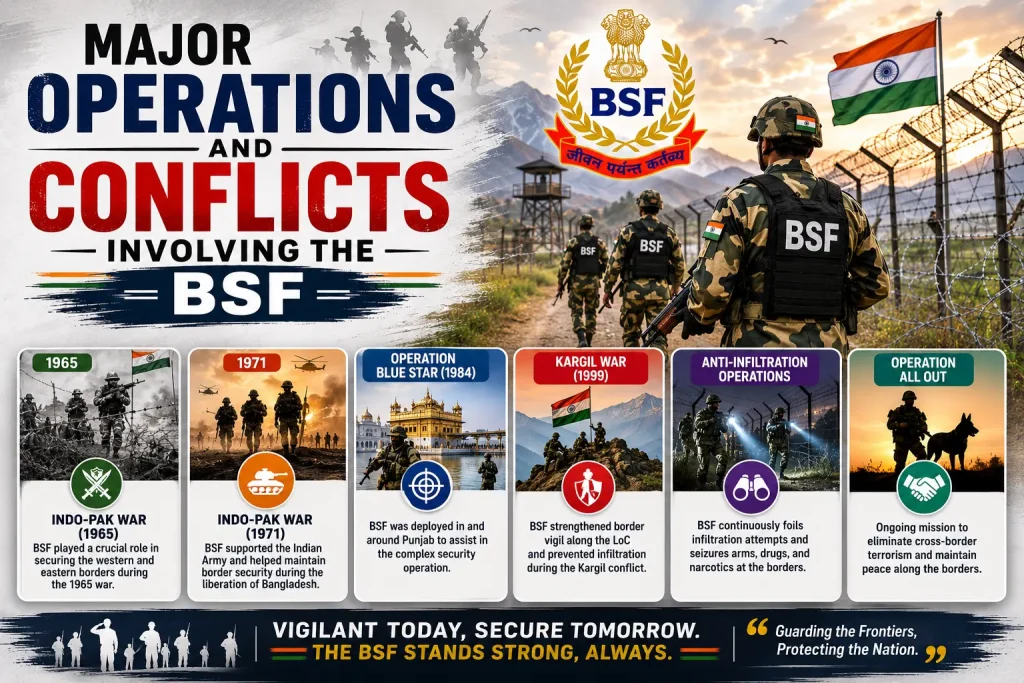
The BSF’s history is closely tied to nearly every major conflict India has faced since 1965, and this operational record is rarely covered in full-form explainer articles.
- 1965 Indo-Pak War: The force was raised in the immediate aftermath of this conflict, specifically to prevent the coordination failures that had weakened border defence.
- 1971 Bangladesh Liberation War: The BSF played a direct combat role, working alongside the Army and supporting the Mukti Bahini, the Bangladeshi liberation forces. After the war, BSF personnel helped administer parts of the newly liberated territory before civil administration was established.
- Kargil conflict of 1999: While the Army led combat operations, the BSF secured rear areas, guarded vital installations, and prevented infiltration attempts along other sections of the border to ensure the Army could focus on the conflict zone.
- Ongoing counter-infiltration operations: The BSF continues to intercept infiltrators, smugglers, and traffickers along both the western and eastern borders on a near-daily basis, though most of these operations never make national headlines.
- Anti-Naxal deployments: Battalions have been deployed to states affected by left-wing extremism, operating alongside state police and the CRPF.
A Few Facts Worth Knowing
These are details that add real context to the BSF’s identity but rarely appear in a simple full-form definition.
- The BSF’s ceremonial retreat at the Attari-Wagah border, held every evening with Pakistan Rangers, has become a tourist attraction that draws thousands of visitors who travel specifically to watch the synchronized drill and flag-lowering ceremony.
- The BSF also holds a similar joint retreat ceremony with the Border Guard Bangladesh at the Petrapole-Benapole border, though it is far less known internationally than the Wagah ceremony.
- Women have served in the BSF since 2013 in operational combat roles at border outposts, not just administrative posts, marking a significant shift from earlier decades when women were largely restricted to support functions.
- The force maintains its own band, sports teams, and even a mounted camel band that performs at the Republic Day parade every year, a visual that many Indians recognise even without knowing which force it belongs to.
- The BSF runs an extensive dog breeding and training programme, producing detection and tracking dogs that are also supplied to other central forces.
- BSF personnel have received some of India’s highest gallantry awards, including the Ashoka Chakra and Kirti Chakra, for actions during infiltration encounters and counter-terror operations.
- The force has its own publication and welfare programmes for the families of personnel killed in the line of duty, reflecting the high-risk nature of border postings compared to many other government roles.
Life on the Border: What Most Articles Never Mention
BSF full form represents much more than just a border guarding force. One aspect almost entirely missing from existing explainer content is what day-to-day border postings actually involve. BSF personnel posted at forward outposts often live in remote, harsh conditions for extended periods, sometimes with limited connectivity to their families.
Postings can range from the extreme heat of the Rajasthan desert, where daytime temperatures cross 45 degrees Celsius, to the humid, flood-prone terrain of the Sundarbans, where patrolling requires boats rather than vehicles.
Rotational postings are standard practice, meaning personnel are periodically moved between harder and relatively easier assignments to distribute the physical and psychological toll of border duty more evenly across the force. This is part of why BSF training places heavy emphasis not just on combat skills but also on physical endurance and mental resilience.
Community engagement is also a bigger part of BSF life than most people assume. Personnel stationed near border villages frequently run medical camps, blood donation drives, and educational support programmes for local children, since the BSF is often the only government presence many border residents interact with regularly.
This civic dimension is a deliberate strategy: a border area with strong goodwill toward the security force tends to see far less smuggling and infiltration cooperation from local populations.
International Cooperation and Border Diplomacy
The BSF does not operate in isolation. Given that its entire mandate revolves around international boundaries, it regularly engages in coordinated activities with counterpart forces from neighbouring countries.
- With Pakistan Rangers: Periodic flag meetings are held to de-escalate border tensions, discuss ceasefire violations, and coordinate on issues like stray cattle crossing the border or the handover of citizens who accidentally cross over.
- With Border Guard Bangladesh (BGB): Regular coordinated patrols and flag meetings help manage a border that runs through dense, often confusing terrain with numerous enclaves and unfenced stretches.
- Joint training exercises: The BSF occasionally participates in exchange programmes and joint exercises with friendly foreign forces to share best practices in border management technology and tactics.
This diplomatic dimension is part of why senior BSF officers are often involved in discussions that go beyond pure security, touching on bilateral relations between India and its neighbours.
Technology and Modernisation
Border security today looks very different from how it did in 1965, and the BSF has had to modernise significantly to keep pace with new threats, particularly the rise of drone-based smuggling and infiltration attempts.
- Smart fencing: Sections of the border, particularly along vulnerable stretches, have been upgraded with sensor-based smart fencing that alerts personnel to breaches in real time.
- Anti-drone systems: Given the growing use of drones to smuggle weapons and narcotics across the border, the BSF has deployed anti-drone technology capable of detecting and neutralising unauthorised aerial devices.
- Night vision and thermal imaging: Widely used for patrolling during low visibility hours, when infiltration attempts are historically more common.
- Data-driven surveillance: Command centres now integrate camera feeds, sensor data, and patrol reports to give commanders a real-time operational picture rather than relying purely on manual reporting.
This shift toward technology-assisted patrolling has not replaced human personnel but has changed how they operate, allowing smaller teams to cover longer stretches of border more effectively than before.
Common Myths About the BSF, Cleared Up
- Myth: BSF and Army personnel are trained identically. Fact: While both undergo rigorous physical and weapons training, BSF training is specifically oriented toward border patrol tactics, smuggling interdiction, and policing-adjacent duties, whereas Army training is built around full-scale combat operations.
- Myth: The BSF only operates at the physical border line. Fact: The BSF is also deployed for internal security duties, election security, and disaster relief well beyond border areas, particularly during periods of civil unrest.
- Myth: Anyone can transfer directly from the Army to the BSF or vice versa. Fact: While both fall under different recruitment and service structures, and personnel occasionally move between central forces at certain levels through specific processes, the two are governed by entirely separate recruitment rules, and there is no automatic transfer path.
- Myth: BSF salary is the same regardless of posting location. Fact: As shown earlier, allowances vary significantly based on terrain, climate, and risk level of the posting, meaning two personnel of the same rank can have noticeably different take-home pay.
Why the BSF Matters
Beyond the ceremonial parades and the widely photographed Wagah retreat, the BSF’s real significance lies in the quiet, continuous work that rarely makes headlines. Every day, thousands of kilometres of India’s land border are watched, patrolled, and defended by personnel who spend years away from urban comforts, often in some of the harshest terrain the country has to offer.
Understanding the BSF full form is just the starting point. The bigger picture is a force that blends the discipline of the military with the on-ground responsibilities of policing, all while maintaining a presence in some of the most sensitive geopolitical zones in South Asia.
Whether it is intercepting a smuggling attempt at 3 a.m. in the desert, running a school for border village children, or standing at attention during the evening retreat ceremony watched by thousands of tourists, the BSF’s work touches far more of Indian life than its abbreviation alone suggests.
Frequently Asked Questions
What is the full form of BSF?
BSF stands for Border Security Force. It is one of India’s primary border guarding forces responsible for protecting the country’s international borders.
What is the role of the Border Security Force (BSF)?
The BSF guards India’s borders with Pakistan and Bangladesh, prevents illegal infiltration and smuggling, supports internal security operations, and assists the Indian Army during wartime.
When was the BSF established?
The Border Security Force was established on 1 December 1965 following the Indo-Pakistan War of 1965 to strengthen India’s border security.
Which ministry controls the BSF?
The BSF functions under the Ministry of Home Affairs (MHA), Government of India.
What are the eligibility criteria to join the BSF?
Eligibility depends on the post. Candidates generally need to meet the required educational qualifications, age limit, physical standards, and clear written exams, physical tests, and medical examinations.
What is the salary of a BSF officer or constable?
The salary varies by rank. A BSF Constable starts with a basic pay of ₹21,700 per month, while officers receive higher salaries along with allowances such as DA, HRA, and risk allowances.
What is the motto of the BSF?
The official motto of the Border Security Force is “Duty Unto Death.” It reflects the force’s commitment to protecting the nation’s borders under all circumstances.
Final Thoughts
The BSF (Border Security Force) is one of India’s most important border guarding forces, playing a crucial role in protecting the nation’s sovereignty and ensuring border security. Beyond guarding international borders, BSF personnel are involved in counter-smuggling operations, disaster relief, internal security, and supporting the Indian Army during times of conflict.
Understanding the BSF full form and its responsibilities provides valuable insight into the dedication and sacrifices of the force. Whether you’re preparing for competitive exams or simply looking to expand your general knowledge, learning about the BSF helps you appreciate its vital contribution to India’s safety and security.
You May Also Like It:
https://formopedia.com/railway-ntpc-full-form-in-hindi/