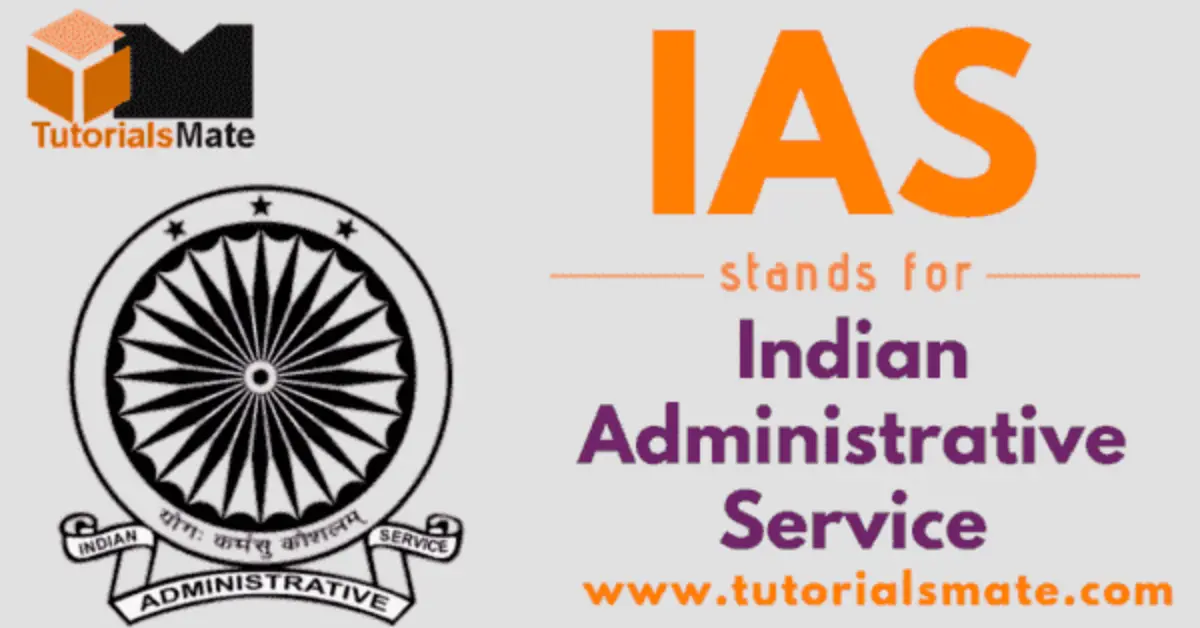

IAS Full Form is one of the most searched queries among UPSC aspirants and students in India. If you have ever come across the term IAS and wondered what it stands for, you are not alone. It is one of the most searched abbreviations in India, and for good reason. It represents one of the most respected careers in the country.
The IAS full form is Indian Administrative Service. It is the administrative backbone of the Indian government, responsible for running everything from a small village block office to major national policies.
This guide, like our other blogs, breaks down what IAS actually means, how the service works, what officers do, and what it takes to join, without the jargon.
Quick Answer: IAS Full Form
| Term | Meaning |
|---|---|
| IAS | Indian Administrative Service |
| Formed in | 1950 |
| Governed by | Article 312 of the Constitution of India |
| Recruiting body | Union Public Service Commission (UPSC) |
| Parent category | All India Services |
The Indian Administrative Service is one of three All India Services, alongside the Indian Police Service (IPS) and the Indian Forest Service (IFoS). Officers in these three services can work for both the central government and individual state governments, depending on where they are posted.
A Quick Word on Confusion: Other Things “IAS” Can Mean
Before we go further, it is worth clearing up something most articles skip. Not every “IAS” you find online refers to the Indian civil service.
Depending on the context, IAS can also stand for:
- International Accounting Standards, a set of global accounting rules used before IFRS took over
- Institute of Administrative Sciences, referring to various academic institutions, including ones outside India
- Indian Academy of Sciences, a scientific research body
If your search results ever seem oddly unrelated to a government exam, this is usually why. This article focuses only on the Indian Administrative Service, the one connected to the UPSC Civil Services Exam.
What Is the Indian Administrative Service
The Indian Administrative Service is the permanent administrative machinery of the Indian government. Officers in this service are politically neutral, meaning they continue their work regardless of which political party is in power. This continuity is what keeps government offices, districts, and departments functioning smoothly during elections and leadership changes.
IAS officers are involved in:
- Implementing government policies at the ground level
- Managing law and order in districts
- Running welfare schemes and development programmes
- Handling disaster response and relief work
- Overseeing revenue collection and land records
- Advising ministers on policy decisions at the state and central level
In short, they are the link between government policy on paper and government action on the ground.
A Short History: From ICS to IAS
Many people do not realise that the IAS has roots going back to the British colonial period. It evolved from the Indian Civil Service (ICS), often called the “steel frame” of British India.
After independence, the ICS was restructured and renamed the Indian Administrative Service in 1950, with Sardar Vallabhbhai Patel playing a key role in shaping it into a modern civil service for a newly independent nation.
This historical continuity is part of why the service carries so much institutional weight even today.
How Does Someone Become an IAS Officer
There are two main routes into the service:
- Direct recruitment through UPSC: Most officers join this way, by clearing the Civil Services Examination conducted annually by the Union Public Service Commission.
- Promotion from state civil services: A smaller number of officers are promoted into the IAS after years of strong performance in state administrative services.
The UPSC Civil Services Exam, in Brief
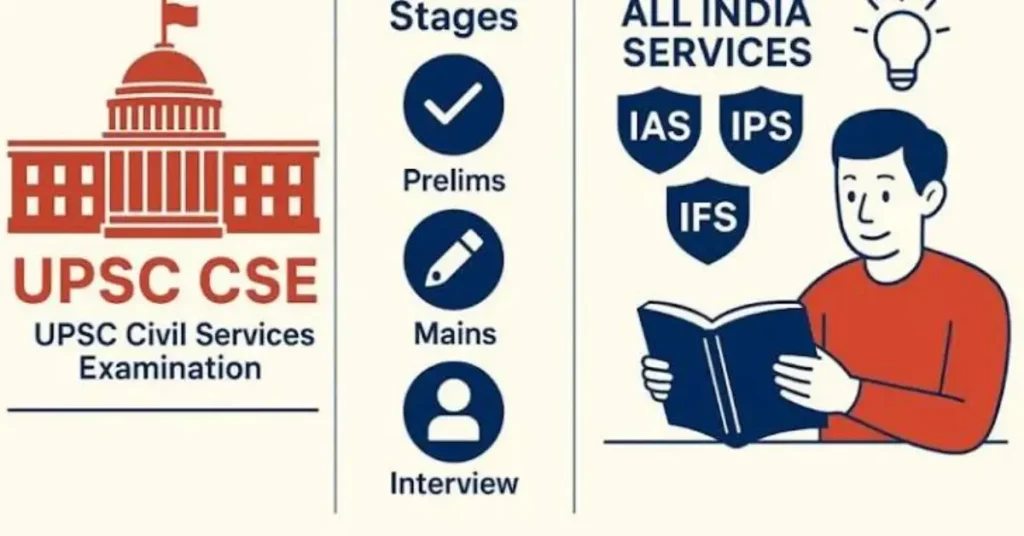
The exam that leads to an IAS post has three stages:
- Preliminary Exam: Two objective-type papers used as a screening round
- Main Exam: Nine written papers, including an essay and optional subject papers
- Personality Test (Interview): A final round assessing a candidate’s suitability for administrative work
Basic Eligibility
- Education: A bachelor’s degree from a recognised university, in any discipline
- Age: Generally between 21 and 32 years, though this varies by category
- Attempts: General category candidates get 6 attempts, OBC candidates get 9, and SC/ST candidates can attempt until the upper age limit
Training After Selection
Candidates who clear all three stages do not step directly into office. They first go through training at the Lal Bahadur Shastri National Academy of Administration (LBSNAA) in Mussoorie, followed by district-level practical training.
Only after this do they take charge as a Sub-Divisional Magistrate, their first field posting.
IAS Officer Salary and Perks
This is one area most articles either skip or oversimplify by quoting a single number. In reality, an IAS officer’s pay has multiple components.
| Component | Details |
|---|---|
| Basic pay range | Approximately ₹56,100 to ₹2,50,000 per month, depending on rank |
| Dearness Allowance (DA) | A percentage of basic pay, revised periodically to offset inflation |
| House Rent Allowance (HRA) | Provided unless official housing is allotted |
| Travel Allowance | Covers official travel and transfers |
| Other perks | Government accommodation, official vehicle with driver, domestic staff, medical benefits, and pension after retirement |
The take-home salary is usually noticeably higher than the basic pay alone, once these allowances are added. This is why comparing only “basic pay” figures across articles can be misleading.
Career Progression: How an IAS Officer Rises Through the Ranks
An IAS career is not a single job title. It is a ladder, and officers move up based on years of service and performance.
| Stage | Approximate Years of Service | Typical Role |
|---|---|---|
| Entry level | 0 to 4 years | Sub-Divisional Magistrate (SDM) |
| Junior level | 5 to 8 years | District Magistrate or Collector |
| Mid level | 9 to 16 years | Divisional Commissioner or Secretary (state department) |
| Senior level | 17 to 30 years | Principal Secretary or Additional Secretary (Government of India) |
| Top level | 30+ years | Chief Secretary (state) or Secretary (Government of India) |
| Apex | Selected officers | Cabinet Secretary, the highest civil post in India |
Not every officer reaches the top, since only one person holds the Cabinet Secretary post at a time. But this table shows the realistic path most officers follow over a career.
IAS vs IPS vs IFoS: What Is the Difference
People often mix up the three All India Services since they are recruited through the same exam. Here is a simple comparison.
| Service | Full Form | Core Work |
|---|---|---|
| IAS | Indian Administrative Service | General administration, policy implementation, district management |
| IPS | Indian Police Service | Law enforcement, internal security, police leadership |
| IFoS | Indian Forest Service | Forest conservation, wildlife management, environmental policy |
All three are prestigious, but they lead to very different day-to-day work. Candidates choose their service preference during the application process, though the final allocation depends on their rank and preference order.
Common Myths About IAS, Cleared Up

- Myth: You need to be an engineering or law graduate to qualify. Fact: A bachelor’s degree in any stream is enough. Many successful officers come from arts, commerce, and science backgrounds.
- Myth: IAS officers only work in a single fixed location. Fact: Officers are transferred regularly, sometimes every 1 to 3 years, and can be posted anywhere within their assigned state cadre or at the centre.
- Myth: Clearing the exam guarantees an IAS post. Fact: Final service allocation depends on a candidate’s rank in the exam and their category. Lower ranks may be allotted to IPS, IFoS, or other central services instead.
Why the IAS Matters
Beyond the prestige, the IAS exists to keep the country running at the ground level. When a new welfare scheme is announced, it is IAS officers who often turn it into an actual functioning programme in villages, towns, and cities. When there is a natural disaster, it is frequently a district collector, an IAS officer, coordinating the relief effort.
Understanding the IAS full form is just the starting point. The real story is how one exam and one service shape the daily functioning of a country of over a billion people.
Frequently Asked Questions
What is the full form of IAS?
IAS stands for Indian Administrative Service.
What is the IAS?
The Indian Administrative Service (IAS) is one of the premier civil services in India. IAS officers are responsible for implementing government policies, managing public administration, and ensuring effective governance.
Who conducts the IAS exam?
The Union Public Service Commission (UPSC) conducts the Civil Services Examination (CSE) to recruit IAS officers.
What is the eligibility for becoming an IAS officer?
Candidates must be Indian citizens, hold a bachelor’s degree from a recognized university, and meet the UPSC age and eligibility requirements.
What are the main responsibilities of an IAS officer?
IAS officers handle district administration, policy implementation, revenue administration, disaster management, and government decision-making at the state and central levels.
Is IAS the highest civil service in India?
Yes, the Indian Administrative Service is considered one of the highest and most prestigious civil services in India.
What is the salary of an IAS officer?
The starting basic salary of an IAS officer is approximately ₹56,100 per month, excluding allowances such as House Rent Allowance (HRA), Dearness Allowance (DA), and Travel Allowance (TA)
Final Thoughts
The IAS (Indian Administrative Service) is one of the most prestigious and respected civil services in India. IAS officers play a vital role in policy implementation, public administration, and nation-building by ensuring that government programs are effectively executed.
Clearing the UPSC Civil Services Examination requires dedication, consistent preparation, and strong analytical skills. For those aspiring to serve the country and make a meaningful impact on society, becoming an IAS officer is a highly rewarding career path.