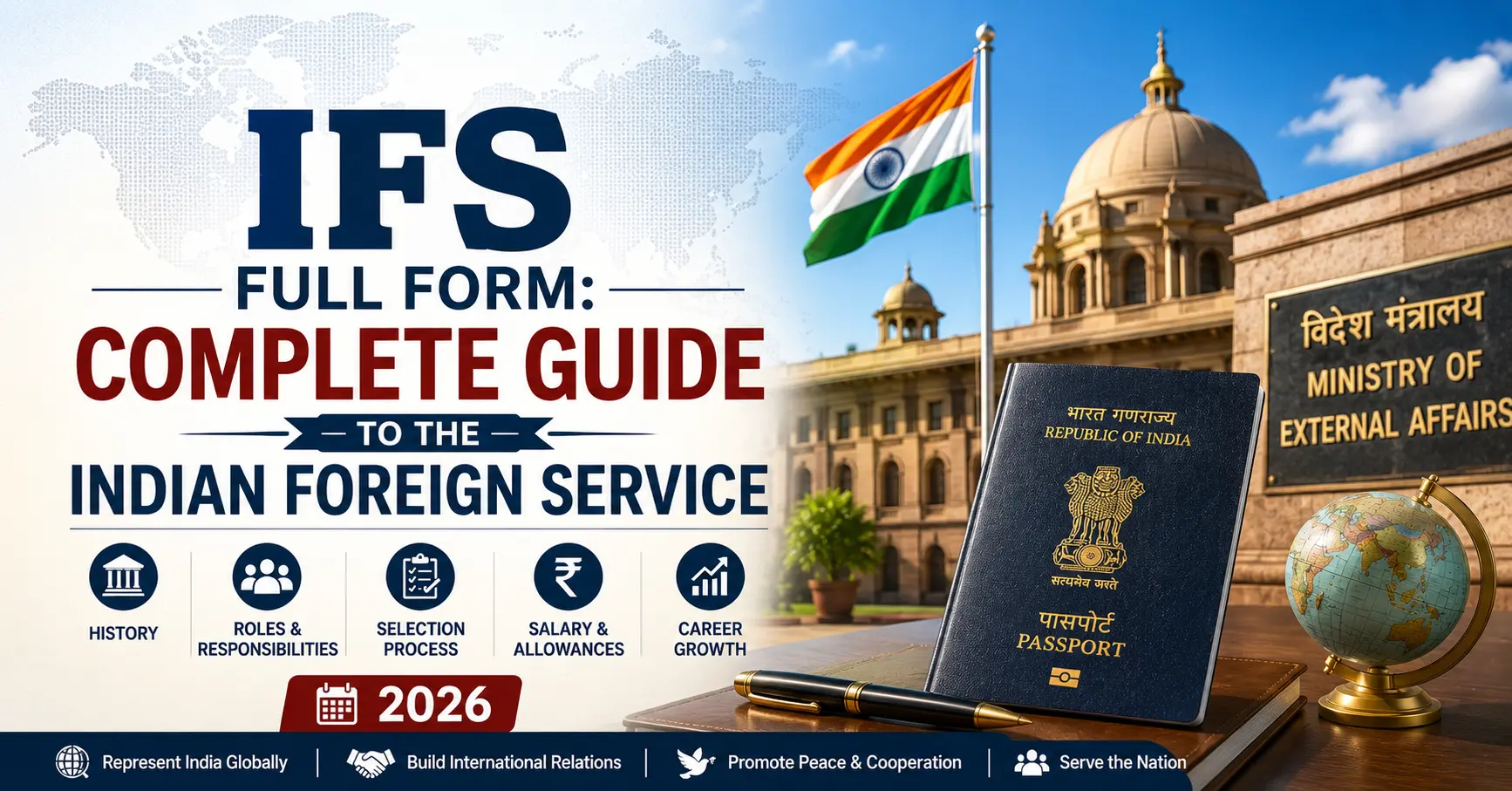

IFS Full Form is Indian Foreign Service. It is one of the three All India Services of the Government of India, alongside the Indian Administrative Service (IAS) and the Indian Police Service (IPS). The Indian Foreign Service is responsible for managing India’s diplomatic relations, representing the country abroad, and safeguarding its interests on the global stage.
Introduction: What Is the IFS Full Form
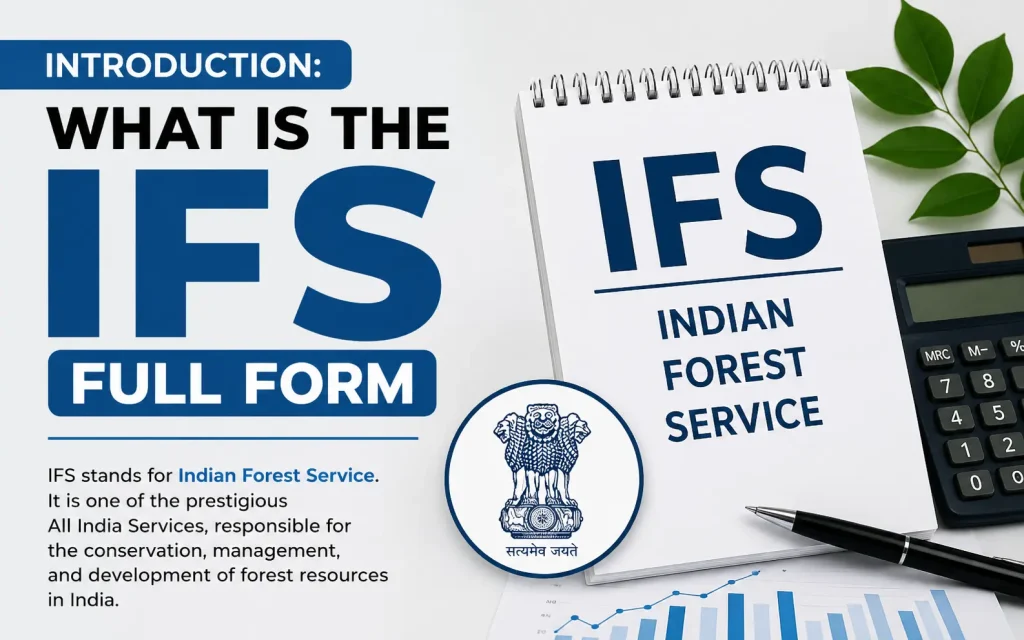
IFS stands for Indian Foreign Service. It is one of the three All India Services of the Government of India, alongside the Indian Administrative Service (IAS) and the Indian Police Service (IPS). Many blogs and career guides discuss the Indian Foreign Service because it is one of the country’s most prestigious diplomatic services.
IFS officers represent India on the world stage. They work as diplomats, negotiators, and policy advisors at Indian embassies, high commissions, and consulates across the globe. They also serve at the Ministry of External Affairs (MEA) in New Delhi.
If you have seen the term “IFS” and wondered what it means, this guide covers everything you need to know, including the history, roles, selection process, salary, and career growth of an IFS officer.
Quick Answer: IFS full form = Indian Foreign Service. (Note: IFS also stands for Indian Forest Service, which is a completely different service. We explain both below.)
A Brief History of the Indian Foreign Service
The IFS has a longer history than most people realize. Its roots go back to 1783, during British rule in India.
Here is a quick timeline:
- 1783: The Board of Directors of the East India Company created a foreign department at Fort William, Calcutta, to handle diplomatic correspondence.
- 1843: Administrative reforms under Governor-General Ellenborough reorganized the government into four departments, including a Foreign Department.
- 1944: A formal proposal to create a dedicated diplomatic service was recorded by Lt-Gen T. J. Hutton, Secretary of the Planning and Development Department.
- 9 October 1946: The Indian Foreign Service was officially established, just a year before India’s independence.
- 1947 onwards: Post-independence, the IFS took full charge of India’s foreign policy and diplomatic representation worldwide.
The IFS emerged from the old Indian Civil Service (ICS) and was designed specifically to handle India’s growing international relationships as a newly independent nation.
What Does an IFS Officer Do
Many people know that IFS officers work at embassies, but the role is far more layered than that.
Core Responsibilities
- Diplomacy and negotiations: Representing India in bilateral and multilateral talks, summits, and international forums such as the United Nations, G20, and SAARC.
- Consular services: Issuing visas, assisting Indian nationals abroad, and authenticating documents.
- Trade and economic promotion: Working with businesses to increase trade between India and host countries.
- Cultural diplomacy: Promoting India’s art, culture, cuisine, and soft power through events, partnerships, and Indian diaspora engagement.
- Intelligence and reporting: Monitoring political developments in host countries and reporting back to the Ministry of External Affairs.
- Crisis management: Protecting and evacuating Indian citizens during natural disasters, wars, or civil unrest abroad. The massive evacuation of Indians from Kuwait during the 1990 Gulf War and from Ukraine in 2022 (Operation Ganga) are landmark examples.
- Treaty and agreement drafting: Participating in the drafting and implementation of bilateral treaties.
Where IFS Officers Are Posted
An IFS officer typically alternates between foreign postings and domestic postings throughout their career.
Foreign postings include:
- Indian Embassies (in countries that do not share a Commonwealth heritage with India)
- Indian High Commissions (in Commonwealth countries)
- Indian Consulates General (in major cities abroad)
- Indian Permanent Missions to international organizations like the UN, WTO, and UNESCO
Domestic postings include:
- Ministry of External Affairs, New Delhi
- Prime Minister’s Office (for senior officers)
- Cabinet Secretariat
- Other central government ministries on deputation
IFS Officer: Key Facts at a Glance
| Detail | Information |
|---|---|
| Full Form | Indian Foreign Service |
| Established | 9 October 1946 |
| Headquarters | South Block, New Delhi |
| Controlling Authority | Ministry of External Affairs (MEA) |
| Total Cadre Strength (2025) | 3,556 officers (Group A: 1,177) |
| Motto | Vasudhaiva Kutumbakam (“The World Is One Family”) |
| Training Institute | Sushma Swaraj Institute of Foreign Service, New Delhi |
| Selection Exam | UPSC Civil Services Examination |
The Motto: Vasudhaiva Kutumbakam
The IFS motto is “Vasudhaiva Kutumbakam,” a Sanskrit phrase from the ancient text Maha Upanishad. It translates to “The World is One Family.”
IFS Full Form is closely associated with India’s core diplomatic values, reflected in the motto “Vasudhaiva Kutumbakam” (The World Is One Family). This motto perfectly captures the philosophy behind Indian diplomacy: building bridges, fostering cooperation, and promoting peace across borders. India’s presidency of the G20 in 2023 also adopted this phrase as its official theme, showing how deeply this idea is embedded in India’s foreign policy identity..
How to Become an IFS Officer: The Selection Process
IFS officers are recruited through the UPSC Civil Services Examination, one of India’s most competitive exams. The same examination recruits IAS and IPS officers, but IFS is a separate service with specific requirements.
Step-by-Step Process
Step 1: Appear in the UPSC Civil Services Preliminary Exam The prelims consist of two papers: General Studies Paper I and CSAT (Civil Services Aptitude Test). This is a qualifying round.
Step 2: Clear the UPSC Mains Exam The mains exam includes nine written papers covering general studies, an essay, optional subjects, and language papers. Your rank largely depends on your mains performance.
Step 3: Clear the Personality Test (Interview) The UPSC board conducts a structured interview to assess communication, judgment, and suitability for a diplomatic career. For IFS specifically, communication skills and international awareness carry extra weight.
Step 4: Rank and Preference After all stages, candidates are ranked. Those who want IFS must indicate it as a service preference. Allocation depends on rank and available vacancies.
Eligibility Criteria
| Criteria | Requirement |
|---|---|
| Nationality | Indian citizen |
| Minimum Age | 21 years |
| Maximum Age | 32 years (with relaxations for OBC, SC/ST, and PwD candidates) |
| Educational Qualification | Bachelor’s degree from a recognized university (any stream) |
| Number of Attempts | 6 attempts (General), 9 attempts (OBC), unlimited (SC/ST, within the prescribed age limit) |
Note: Unlike some specialized services, there is no requirement for a degree in international relations or political science. Engineers, doctors, and humanities graduates all serve as IFS officers.
IFS Officer Salary and Perks (2026)
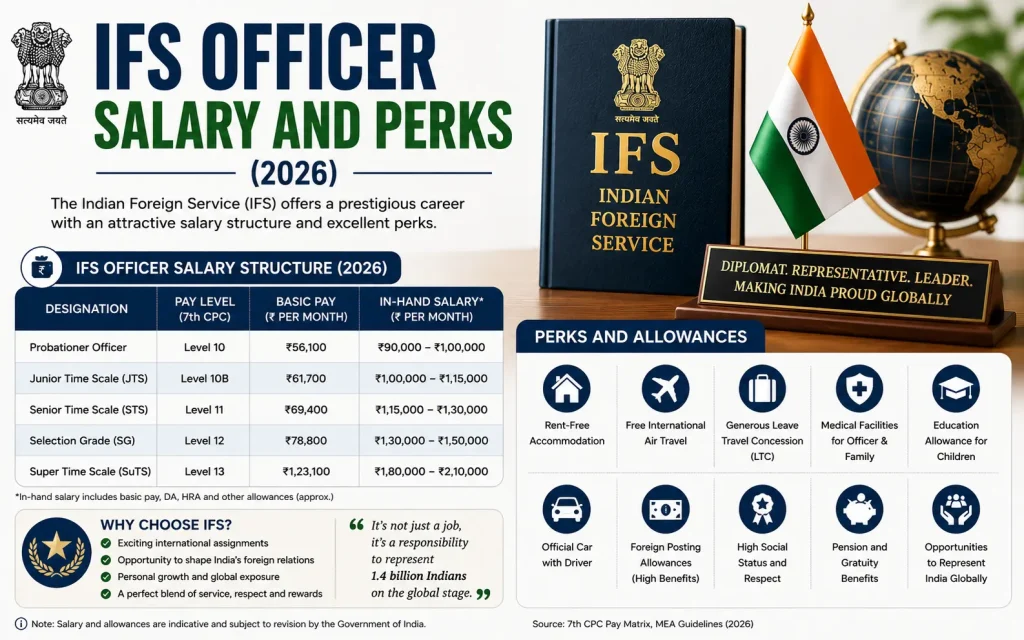
The salary of an IFS officer is governed by the 7th Pay Commission. However, the real value of an IFS posting lies in the allowances and perquisites, which vary by country.
Basic Pay by Level
| Level | Designation | Basic Pay (Per Month) |
|---|---|---|
| Level 10 | Third Secretary | Rs. 56,100 onwards |
| Level 11 | Second Secretary | Rs. 67,700 onwards |
| Level 12 | First Secretary | Rs. 78,800 onwards |
| Level 13 | Counsellor | Rs. 1,18,500 onwards |
| Level 14 | Minister / Deputy Chief of Mission | Rs. 1,44,200 onwards |
| Level 17 | Ambassador / High Commissioner | Rs. 2,25,000 onwards |
Foreign Posting Allowances
When posted abroad, IFS officers receive significant allowances based on the cost of living in the host country. These include:
- Foreign Allowance (FA): Varies by country, often equivalent to several times the basic pay
- Free or heavily subsidized government accommodation in the mission premises
- Official vehicle with a driver
- Children’s education allowance for schooling abroad
- Home travel concession to visit India
Beyond the financial benefits, foreign postings offer exposure to different cultures, access to senior world leaders and policymakers, and the experience of shaping history in real time.
Career Progression: IFS Officer Ranks
An IFS officer’s career follows a structured progression from a junior diplomat to an ambassador or high commissioner.
Here is a typical career trajectory:
- Third Secretary (Probationary period, training at Sushma Swaraj Institute of Foreign Service)
- Second Secretary (First foreign posting, usually after 2-3 years)
- First Secretary (Mid-level posting, 5-8 years of service)
- Counsellor (Senior diplomat, leads sections within a mission)
- Minister / Deputy Chief of Mission (DCM) (Second-in-command at a major embassy)
- Ambassador / High Commissioner (Head of Mission, the top diplomatic post)
- Foreign Secretary (The highest career position, head of the IFS cadre)
The Foreign Secretary is the most senior IFS officer and serves as the principal adviser to the External Affairs Minister on foreign policy matters.
Training: The Sushma Swaraj Institute of Foreign Service
Newly recruited IFS officers undergo training at the Sushma Swaraj Institute of Foreign Service (SSIFS) in New Delhi (renamed from the Foreign Service Institute in 2020 in memory of the late External Affairs Minister Sushma Swaraj).
The training covers:
- Diplomacy and protocol: How international relations work in practice
- Language training: Mandatory learning of a foreign language (such as French, German, Spanish, Japanese, Chinese, Arabic, Russian, or Portuguese)
- International law and treaties: Understanding the legal framework of diplomacy
- Economic diplomacy: Trade negotiations and bilateral economic engagement
- Crisis management and consular work: Handling real-world emergencies
Attachments: Short postings to other Indian ministries and international organizations to build cross-sector knowledge
The initial training period lasts approximately two years before the officer takes up their first foreign posting.
IFS vs. IAS vs. IPS: How Are They Different
A common question is how IFS compares to the other two All India Services.
| Feature | IFS | IAS | IPS |
|---|---|---|---|
| Full Form | Indian Foreign Service | Indian Administrative Service | Indian Police Service |
| Primary Work Domain | Foreign policy and diplomacy | Administration and governance | Law enforcement and security |
| Primary Posting Location | Abroad and Ministry of External Affairs (MEA) | State cadre in India | State cadre in India |
| Key Responsibility | Representing India globally | Running district and state administration | Maintaining law and order |
| Unique Feature | Language training and foreign postings | Cadre-based state allocation | Uniformed service |
All three are recruited through the same UPSC exam. IFS is generally considered equally prestigious to IAS, with the added appeal of an international career.
IFS Full Form: Indian Foreign Service vs. Indian Forest Service
This is one of the most important clarifications in this article. IFS is an abbreviation used for two entirely different services:
Indian Foreign Service (IFS)
- Handles India’s foreign policy and international diplomacy
- Officers work at embassies, high commissions, and the MEA
- Part of the Central Services (Group A)
- Selected through UPSC Civil Services Examination
Indian Forest Service (IFS)
- Handles management, conservation, and development of India’s forests and wildlife
- Officers work across state forest departments and central environmental bodies
- Part of the All India Services (Group A)
- Selected through the separate UPSC Indian Forest Service Examination, not the Civil Services Exam
The key difference: Indian Foreign Service officers are diplomats. Indian Forest Service officers are forest and wildlife administrators. Both use “IFS” as their abbreviation, which causes frequent confusion.
When someone asks “what is the IFS full form,” they usually mean Indian Foreign Service in the context of UPSC Civil Services and diplomacy. If the context is environment or ecology, they likely mean Indian Forest Service.
Other Meanings of IFS
In other contexts, IFS can stand for:
- Indian Financial Service (a Group A Central Service dealing with financial management in government departments)
- Installment Financial Services (used in banking and finance contexts)
- International Financial Statistics (used by the IMF)
- Integrated File System (used in computer science and IBM AS/400 systems)
In the context of government careers and UPSC preparation in India, IFS almost always refers to Indian Foreign Service.
Why Choose the Indian Foreign Service
Many UPSC aspirants wonder whether to prefer IAS or IFS. Here are some genuine reasons candidates choose IFS:
- International exposure: Very few careers offer the chance to live and work in multiple countries across different continents.
- Language skills: The mandatory foreign language training opens up lifelong personal and professional opportunities.
- Policy impact: IFS officers directly shape India’s relationships with foreign governments, international bodies, and global institutions.
- Quality of life abroad: Official housing, schooling support, and allowances make postings financially rewarding.
- Unique experiences: From negotiating trade deals to responding to crises, no two postings are the same.
- Prestige and purpose: Representing a nation of 1.4 billion people on the world stage carries both responsibility and pride.
Challenges of the Indian Foreign Service
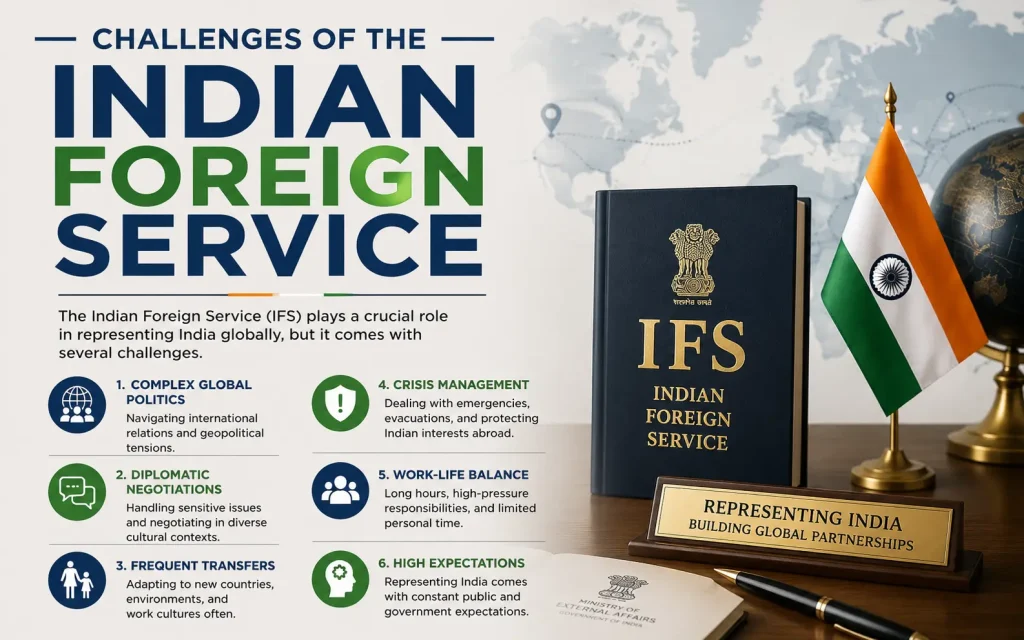
The IFS is not without its challenges. Honest coverage of this career must include:
- Frequent relocations: Officers and their families move every 3-4 years. This can disrupt children’s schooling and a spouse’s career.
- Hardship postings: Some postings are in countries with harsh climates, political instability, or limited infrastructure.
- Long hours during crises: Major diplomatic events, elections in the host country, or emergencies can mean round-the-clock work.
- Limited domestic presence: If you prefer staying in India and are close to your roots, the frequent foreign postings can feel isolating.
- High stakes: Diplomatic errors can have consequences at the national level. The pressure is constant.
- These challenges are real, but most IFS officers describe their careers as deeply fulfilling despite them.
Frequently Asked Questions (FAQs)
What is the full form of IFS?
IFS stands for Indian Foreign Service, the diplomatic service of the Government of India responsible for managing the country’s foreign relations and representing India abroad.
How can I become an IFS officer?
You can become an IFS officer by clearing the UPSC Civil Services Examination and securing a high enough rank to be allotted the Indian Foreign Service.
Is IFS different from the Indian Forest Service?
Yes. Indian Foreign Service deals with diplomacy and international relations, while the Indian Forest Service manages forests, wildlife, and environmental conservation. Although both use the abbreviation “IFS,” they are separate services.
What is the salary of an IFS officer?
An entry-level IFS officer earns a basic salary starting at ₹56,100 per month. Officers posted abroad also receive foreign allowances, accommodation, and other benefits, making the overall package significantly higher.
Where do IFS officers work?
IFS officers work in Indian embassies, high commissions, consulates, permanent missions to international organizations, and the Ministry of External Affairs (MEA) in New Delhi.
What qualifications are required to join the IFS?
Candidates must have a bachelor’s degree from a recognized university, be at least 21 years old, and meet the eligibility criteria prescribed by the UPSC.
Do IFS officers receive foreign language training?
Yes. Newly recruited IFS officers receive mandatory foreign language training and are assigned a language based on their first overseas posting.
Final Thoughts
The Indian Foreign Service is one of India’s most prestigious and intellectually demanding careers. IFS officers do far more than attend diplomatic dinners. They negotiate trade deals, protect Indian citizens abroad, build strategic partnerships, and help shape the foreign policy of one of the world’s largest nations.
Whether you are a UPSC aspirant researching your career options or simply someone who looked up “IFS full form” out of curiosity, the Indian Foreign Service is a fascinating institution that carries India’s voice to every corner of the world.
If you found this guide helpful, explore related topics such as the UPSC Civil Services Examination pattern, IAS vs. IFS comparison, and top IFS officers who shaped India’s diplomatic history.
You May Also Like It:
CUTS Full Form in English and Hindi