Introduction
SSC Full Form is one of the most searched queries among government job aspirants in India. If you have ever searched for a government job in India, you have almost certainly come across the term “SSC.” But what does SSC stand for, and why does it matter so much to millions of Indian job seekers every year?
SSC full form is Staff Selection Commission. It is a central government body that recruits candidates for a wide range of posts across various ministries, departments, and subordinate offices of the Government of India.
In this SSC Full Form blog, you will learn everything about SSC, including its full form, history, purpose, major exams, eligibility criteria, salary benefits, and practical tips to get started. Whether you are a first-time aspirant or simply looking for a quick refresh, this comprehensive blog covers everything you need to know about SSC.
What Is SSC? A Clear, Simple Answer

SSC stands for Staff Selection Commission.
It is an autonomous organization functioning under the Department of Personnel and Training (DoPT), Ministry of Personnel, Public Grievances and Pensions, Government of India.
SSC Full Form refers to the Staff Selection Commission, the central recruitment agency for Group B and Group C government jobs in India. Think of SSC as the central hiring agency for these positions. Just as private companies have HR departments for recruitment, SSC performs that function for the central government on a massive scale.
Every year, SSC conducts multiple examinations and selects hundreds of thousands of candidates for posts in:
- Central government ministries and departments
- Subordinate offices under the central government
- Constitutional bodies and attached offices
History and Background of SSC
Understanding the roots of SSC helps you appreciate why it holds such authority in India’s recruitment landscape.
- 1975: The Government of India established the Subordinate Services Commission to handle recruitment for non-gazetted Group C and Group D posts.
- 1977: It was renamed the Staff Selection Commission (SSC), which is the name still used today.
- 2003 onwards: SSC gradually shifted its examinations to a computer-based format to increase transparency and efficiency.
- Today: SSC operates through a headquarters in New Delhi and nine regional offices spread across the country, covering every state and union territory.
SSC Full Form represents the Staff Selection Commission, an organization with a long and distinguished history of recruiting candidates for central government jobs. This legacy has allowed SSC to develop refined recruitment processes over decades, making it one of the most credible, trusted, and transparent recruitment bodies in India.
Other Full Forms of SSC (Do Not Confuse These)
SSC is an acronym used in multiple contexts. Here is a clear breakdown so you never confuse them:
| Abbreviation | Full Form | Context |
|---|---|---|
| SSC | Staff Selection Commission | Central government recruitment (India) |
| SSC | Secondary School Certificate | Board exam after Class 10 (Maharashtra, Gujarat, Goa, etc.) |
| SSC | Social Security Contributions | Finance and taxation |
| SSC | Shared Service Center | Corporate/business operations |
| SSC | Secondary School Certificate | Pakistan’s Grade 10 board exam |
This article focuses entirely on SSC as Staff Selection Commission, which is the most widely searched meaning in the Indian government job context.
Why SSC Is So Important in India
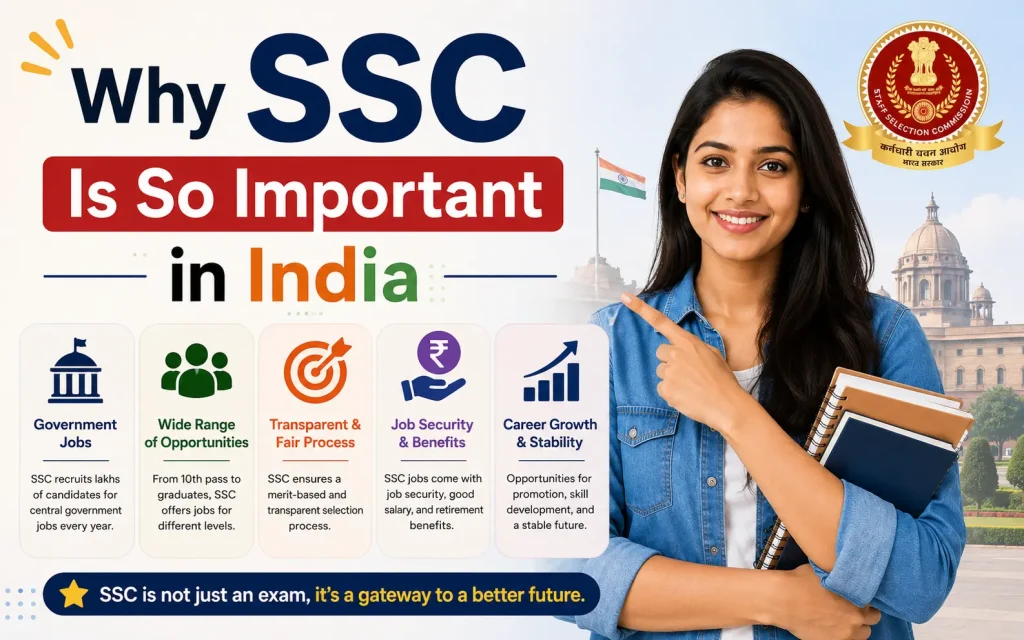
SSC is not just another government body. Here is why it is central to the careers of millions:
- Scale: SSC conducts exams for over 1 lakh (100,000) vacancies annually.
- Reach: Candidates from all 28 states and 8 union territories can apply.
- Accessibility: Most SSC exams require only a Class 10 or Class 12 pass certificate, making them accessible to a very large population.
- Job security: SSC jobs come with permanent government employment, pension, and allowances.
- Salary: Pay ranges from around Rs. 18,000 per month for entry-level posts to over Rs. 1,77,500 per month for top Group B gazetted posts.
These factors make SSC one of the most sought-after recruitment bodies in the country, alongside UPSC.
SSC Full Form: All Major SSC Exams – A Complete List
SSC conducts a range of examinations across different eligibility levels. Here is a comprehensive overview:
SSC CGL (Combined Graduate Level Examination)
- Eligibility: Graduate degree from a recognized university
- Posts: Income Tax Inspector, Auditor, Accountant, Sub-Inspector (CBI), Statistical Investigator, and many more
- Exam pattern: Tier 1 (CBE), Tier 2 (CBE)
- Why it is popular: Offers some of the most prestigious Group B and Group C posts with excellent salaries and perks
SSC CHSL (Combined Higher Secondary Level Examination)
- Eligibility: Class 12 pass
- Posts: Data Entry Operator (DEO), Lower Division Clerk (LDC), Junior Secretariat Assistant (JSA), Postal Assistant
- Exam pattern: Tier 1 (CBE), Tier 2 (CBE including a skill test)
- Why it is popular: Entry-level opportunity for candidates who have cleared their 12th board exams
SSC MTS (Multi-Tasking Staff Examination)
- Eligibility: Class 10 pass
- Posts: Multi-Tasking Staff (clerical and general duties), Havaldar
- Exam pattern: Computer-based test followed by a Physical Efficiency Test (PET) for Havaldar posts
- Why it is popular: Most accessible SSC exam; no higher qualification needed
SSC JE (Junior Engineer Examination)
- Eligibility: Diploma or degree in Civil, Electrical, Mechanical, or Quantity Surveying engineering
- Posts: Junior Engineer in CPWD, CWC, MES, Farakka Barrage Project, and Border Roads Organisation
- Exam pattern: Paper 1 (CBE) and Paper 2 (descriptive)
- Why it is popular: Ideal for engineering diploma holders seeking a stable government career
SSC GD Constable (General Duty)
- Eligibility: Class 10 pass, age 18 to 23 years
- Posts: Constable in BSF, CISF, CRPF, ITBP, NIA, SSF, SSB, and Assam Rifles
- Exam pattern: CBE, PET, PST, medical examination
- Why it is popular: Lakhs of vacancies released in a single cycle; one of the largest SSC exams by volume
SSC CPO (Central Police Organisations Examination)
- Eligibility: Graduate degree, specific physical standards
- Posts: Sub-Inspector in CAPF (BSF, CRPF, CISF, ITBP, SSB), ASI in CISF
- Exam pattern: Paper 1 (CBE), PET, Paper 2 (CBE), medical examination
- Why it is popular: One of the few SSC exams that leads to a uniformed service post
SSC Stenographer Grade C and D Examination
- Eligibility: Class 12 pass
- Posts: Stenographer Grade C and Grade D in various ministries and departments
- Exam pattern: CBE followed by a stenography skill test
- Why it is popular: Strong demand for Stenographers in Parliament, courts, and central departments
SSC JHT (Junior Hindi Translator Examination)
- Eligibility: Master’s degree in Hindi or English with the other as a main subject at degree level
- Posts: Junior Hindi Translator, Junior Translator, Senior Hindi Translator
- Why it is popular: Niche exam with less competition; ideal for language graduates
SSC Selection Post Examination
- Eligibility: Varies by post (Class 10, Class 12, or Graduate level)
- Posts: Wide variety of posts across different pay levels released in each phase
- Why it is unique: Covers a broad spectrum of vacancies in a single notification
SSC Salary Structure: What You Can Earn
One of the biggest attractions of SSC jobs is the pay and benefits. Here is a realistic salary overview based on the 7th Pay Commission:
| Exam | Entry-Level Pay Scale | Approximate In-Hand Salary |
|---|---|---|
| SSC MTS | Pay Level 1 (Rs. 18,000 basic) | Rs. 20,000 to Rs. 25,000 |
| SSC CHSL | Pay Level 4 (Rs. 25,500 basic) | Rs. 30,000 to Rs. 40,000 |
| SSC CGL | Pay Level 6–8 (Rs. 35,400 to Rs. 47,600 basic) | Rs. 45,000 to Rs. 80,000+ |
| SSC JE | Pay Level 6 (Rs. 35,400 basic) | Rs. 45,000 to Rs. 55,000 |
| SSC CPO | Pay Level 6 (Rs. 35,400 basic) | Rs. 45,000 to Rs. 60,000 |
Beyond the basic pay, SSC employees receive:
- House Rent Allowance (HRA)
- Dearness Allowance (DA), revised twice a year
- Transport Allowance
- Medical benefits for self and family
- Pension under the National Pension System (NPS)
- Leave Travel Concession (LTC)
SSC vs. UPSC: Key Differences
Many aspirants get confused between SSC and UPSC. Here is a simple comparison:
| Factor | SSC | UPSC |
|---|---|---|
| Full Form | Staff Selection Commission | Union Public Service Commission |
| Posts | Group B and Group C (non-gazetted and some gazetted posts) | Group A and Group B (mainly gazetted posts) |
| Level of Exam | Moderate to high competition | Very high competition |
| Minimum Qualification | Class 10 to Graduate (depending on the exam) | Mostly Graduate and above |
| Posts Offered | Inspector, Clerk, Constable, JE, Stenographer | IAS, IPS, IFS, and other All India Services |
| Interview Requirement | Only for selected SSC CGL posts | Mandatory for most UPSC examinations |
SSC Full Form highlights the Staff Selection Commission, which serves as the gateway to a wide range of Group B and Group C central government jobs in India. In contrast, UPSC primarily recruits candidates for the prestigious All India Services and higher administrative roles, making the two organizations distinct in their recruitment scope and career paths.
How SSC Conducts Its Exams: The Process Explained
SSC follows a well-structured recruitment process. Here is how it works, step by step:
- Notification release: SSC publishes an official notification on ssc.gov.in with vacancy details, eligibility, exam dates, and application links.
- Online application: Candidates apply through the official SSC website within the announced window.
- Admit card: Hall tickets are released a few weeks before the exam date.
- Computer-Based Examination (CBE): Most exams start with an objective-type computer-based test.
- Additional stages: Depending on the post, subsequent stages may include a second-tier exam, skill test, physical test, or document verification.
- Final merit list: SSC prepares and publishes a final merit list based on combined scores across all stages.
- Document verification: Shortlisted candidates verify their original documents at a designated regional office.
- Joining: Selected candidates receive offer letters and join their allotted posts.
Eligibility Criteria: A Quick Reference
Eligibility varies by exam. Here is a general overview:
Nationality: Must be a citizen of India (some posts also accept citizens of Nepal, Bhutan, or Tibetan refugees with specific conditions).
Age: Generally between 18 and 32 years, varying by post. Age relaxation applies for SC, ST, OBC, PwD, Ex-Servicemen, and other reserved categories as per government norms.
Educational Qualification:
Class 10 pass: SSC MTS, SSC GD Constable
Class 12 pass: SSC CHSL, SSC Stenographer
Graduate: SSC CGL, SSC CPO, SSC JHT (with specific subject requirements)
Engineering Diploma or Degree: SSC JE
How to Apply for SSC Exams: A Step-by-Step Guide
Applying for SSC is straightforward if you follow these steps:
- Register on ssc.gov.in: Create a one-time registration using your mobile number and email address.
- Check the notification: Read the official notification carefully to confirm your eligibility.
- Fill the application form: Enter your personal, educational, and contact details.
- Upload documents: Scan and upload your photograph and signature in the prescribed format.
- Pay the application fee: Rs. 100 for General and OBC male candidates. Female candidates, SC, ST, PwD, and Ex-Servicemen are typically exempted.
- Submit and save: Submit the form and download a copy for future reference.
Top Tips to Crack SSC Exams

Cracking an SSC exam requires consistent effort and a smart strategy. Here are practical tips that actually work:
Understand the exam pattern first. Before opening any book, download the official notification and study the exam pattern and syllabus. Know what you are preparing for.
Build your foundation in four core subjects. SSC Tier 1 exams test General Intelligence (Reasoning), Quantitative Aptitude, English Language, and General Awareness. Strengthen all four equally.
Practice with previous year papers. SSC has years of past papers available. Solving them is the single best way to understand question patterns, difficulty levels, and time management.
Take timed mock tests. Time pressure in SSC exams is real. Regular mock tests under exam-like conditions build both speed and accuracy.
Focus on Current Affairs consistently. General Awareness includes static GK (history, geography, polity, science) and current affairs. Read a quality daily news source and revise regularly.
Do not ignore English. Many aspirants from Hindi-medium backgrounds underestimate the English section. Invest time in vocabulary, grammar, and reading comprehension.
Revise, revise, revise. One round of studying is never enough. Schedule regular revision cycles so you retain what you learn.
Frequently Asked Questions (FAQs) About SSC Full Form
What is the full form of SSC?
The full form of SSC is Staff Selection Commission. It is a government organization responsible for recruiting candidates for various Group B and Group C posts in ministries, departments, and offices of the Government of India.
What is the role of the Staff Selection Commission (SSC)?
SSC conducts competitive examinations to recruit eligible candidates for central government jobs, including positions such as CGL, CHSL, MTS, GD Constable, JE, Stenographer, and CPO.
Is SSC a government organization?
Yes, SSC is a government organization established by the Government of India. It functions under the Department of Personnel and Training (DoPT), Ministry of Personnel, Public Grievances and Pensions.
Who is eligible to apply for SSC exams?
Eligibility depends on the specific exam. Some SSC exams require a Class 10 qualification, while others require Class 12 or a Bachelor’s degree from a recognized institution.
Which are the most popular SSC exams?
Some of the most popular SSC exams include:
SSC CGL (Combined Graduate Level)
SSC CHSL (Combined Higher Secondary Level)
SSC MTS (Multi-Tasking Staff)
SSC GD Constable
SSC JE (Junior Engineer)
SSC Stenographer
SSC CPO (Central Police Organization)
What is the age limit for SSC exams?
The age limit varies by examination and post. Most SSC exams have an age range between 18 and 32 years, with age relaxation available for reserved categories as per government rules.
What is the difference between SSC and UPSC?
SSC mainly recruits candidates for Group B and Group C central government posts, whereas UPSC conducts examinations for prestigious Group A services such as IAS, IPS, and IFS.
Final Thoughts
SSC, or Staff Selection Commission, is one of the most important recruitment bodies in India. It opens doors to stable, well-paying government jobs for candidates from Class 10 pass all the way up to graduates and engineers.
SSC Full Form is important to understand whether you are aiming for a prestigious SSC CGL post or beginning your journey with SSC MTS. Knowing the organization, its exams, and its recruitment process gives you a significant head start and helps you prepare more confidently for a central government career.
Start with the exam most suited to your current qualification, study consistently, and use official resources from ssc.gov.in. A government job through SSC is an achievable goal for anyone who puts in the right effort.
Good luck.
You May Also Like It:
RES Full Form in English and Hindi