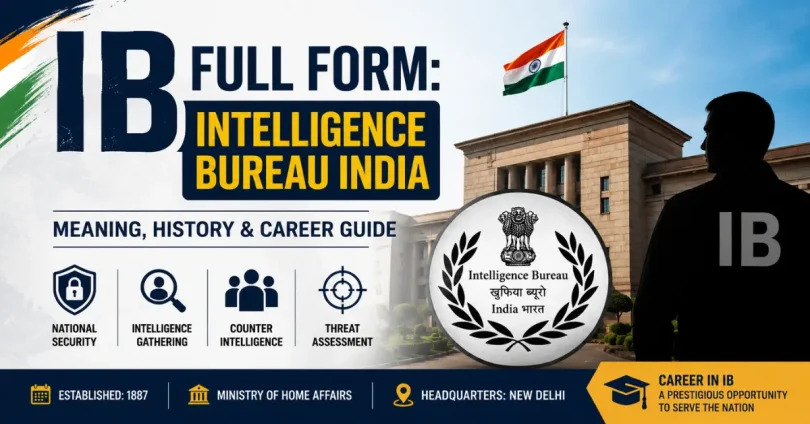

IB stands for Intelligence Bureau. It is India’s primary internal intelligence and counterintelligence agency, functioning under the Ministry of Home Affairs. Founded in 1887, the IB collects domestic intelligence, monitors internal security threats, and coordinates with law enforcement to protect national security.
What IB Stands For (Context-Wise)
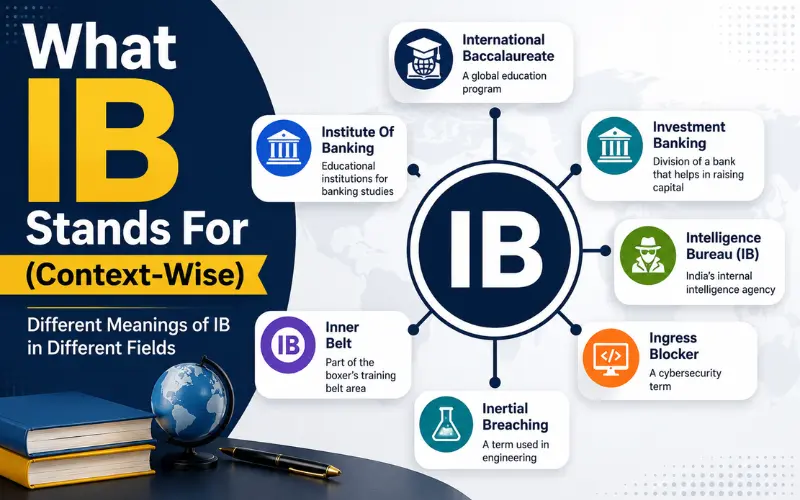
Most people searching “IB full form” are looking for one specific answer, but IB is actually used in several distinct fields. Getting the context wrong can send you down the wrong path entirely.
| Context | IB Full Form | Who Uses It |
| Indian Govt. / UPSC / Defence | Intelligence Bureau | Civil service aspirants, security professionals |
| Education (International) | International Baccalaureate | School students, parents, educators |
| Finance / Banking | Investment Banking | Finance professionals, MBA graduates |
| Pharma / Lab | Inclusion Body | Medical researchers, biologists |
For UPSC aspirants, government exam candidates, and anyone studying Indian polity or internal security, IB Intelligence Bureau is the meaning you need.
What Is the Intelligence Bureau (IB)
The Intelligence Bureau is India’s oldest active intelligence organization. It handles internal threats only, which is a critical distinction that most articles gloss over. Everything that happens within India’s borders, from insurgency monitoring to VIP threat assessment, falls under the IB’s radar.
It is not a law enforcement agency. The IB cannot arrest anyone. It gathers, analyses, and shares intelligence with agencies like the CBI, NIA, and state police forces, which then act on it.
Key facts at a glance:
- Full name: Intelligence Bureau
- Ministry: Ministry of Home Affairs (MHA)
- Jurisdiction: Domestic (within India’s borders only)
- Headquarters: New Delhi
- Head: Director, Intelligence Bureau (DIB)
- Reporting chain: DIB reports to the Union Home Minister, who reports to the Prime Minister
- Founded: 1887 (as the Central Special Branch)
The History Competitors Skip Over
The IB was not born in independent India. The British colonial administration created it in 1887 as the “Central Special Branch” specifically to monitor political dissent, revolutionary activities, and any organized resistance to British rule.
After 1947, newly independent India inherited the institution, renamed it the Intelligence Bureau, and repurposed it for national security. This colonial origin has a practical consequence that often surprises people: the IB operates without a dedicated statutory law.
Unlike the CBI (which derives authority from the Delhi Special Police Establishment Act) or the NIA (governed by the NIA Act 2008), the IB functions purely under executive authority and the Government of India’s administrative orders.
This means no parliamentary oversight law governs its operations directly, a fact that has sparked ongoing policy debates among civil liberties experts and security analysts.
Core Functions of the Intelligence Bureau
Internal Security and Counterintelligence
The IB’s primary job is identifying threats before they escalate. This includes monitoring:
- Separatist and insurgent movements (Naxalism, Northeast insurgencies)
- Cross-border infiltration networks
- Foreign espionage operations inside Indian territory
- Radicalization trends and sleeper cells
Counterintelligence means the IB actively works to detect and neutralize foreign spies operating inside India. While RAW (Research and Analysis Wing) runs agents abroad, the IB hunts foreign agents on Indian soil.
Counter-Terrorism
The IB feeds real-time intelligence to the Multi-Agency Centre (MAC), a nerve center established after the Kargil war to force information sharing between India’s often-siloed intelligence agencies. The MAC connects IB with RAW, NIA, state police intelligence units, the Defence Intelligence Agency, and others.
When a terrorist plot is disrupted before it happens, IB intelligence is frequently the trigger, even if the actual arrests are made by the NIA or state police.
VIP Security Assessment
Before the Security Protection Group (SPG) or state police deploy security for a dignitary, the IB conducts a threat assessment. This covers the Prime Minister, Chief Ministers, foreign heads of state visiting India, and other high-risk public figures. The IB does not physically protect anyone; it tells the protection team what the threat level looks like.
Cyber Intelligence
This is an area most full-form articles ignore entirely. The IB has expanded its mandate into cyber threat monitoring over the last decade. State-sponsored cyberattacks, critical infrastructure vulnerabilities, and digital surveillance of terror networks now form a significant part of the bureau’s modern operational scope.
Border Intelligence
The IB coordinates with the Border Security Force (BSF) and the Sashastra Seema Bal (SSB) on border intelligence, tracking smuggling networks, identifying infiltration routes, and monitoring cross-border communication patterns.
IB vs RAW vs CBI: The Differences That Actually Matter
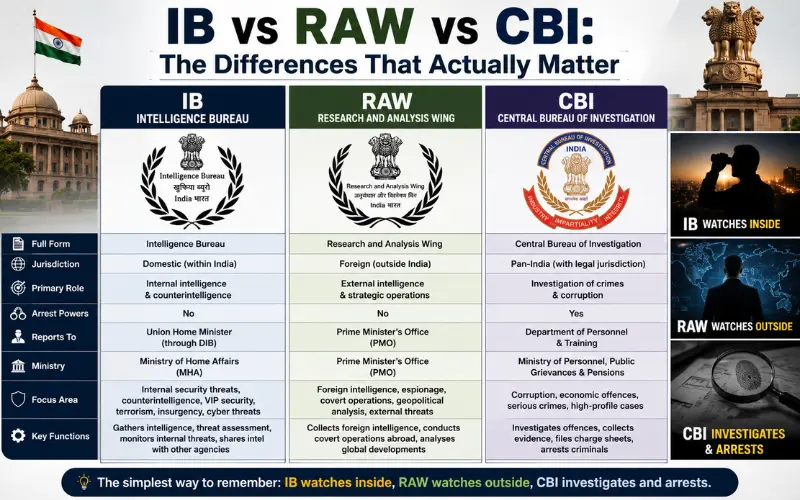
This comparison trips up UPSC aspirants and general readers alike, because all three agencies deal with “intelligence” in some form.
IB (Intelligence Bureau):
- Domestic jurisdiction only
- No arrest powers
- Reports to Ministry of Home Affairs
- Handles internal threats and counterintelligence
RAW (Research and Analysis Wing):
- Foreign intelligence only
- No domestic operations (legally)
- Reports directly to the Prime Minister’s Office
- Handles external threats, covert operations abroad
CBI (Central Bureau of Investigation):
- Investigative, not purely an intelligence agency
- Has arrest powers
- Reports to Ministry of Personnel
- Handles corruption, financial crime, high-profile criminal cases
The simplest way to remember: IB watches inside, RAW watches outside, CBI investigates and arrests.
The IB ACIO Exam: Your Career Entry Point
Thousands of people search “IB full form” not because they are curious about the agency in general, but because they want to join it. The main entry route for graduates is the IB ACIO (Assistant Central Intelligence Officer) Grade II/Executive examination.
In 2025, the IB released a major notification for 3,717 ACIO Grade II/Executive posts, making it one of the largest central government recruitment drives of the year.
Eligibility snapshot:
- Qualification: Any bachelor’s degree from a recognized university
- Age limit: 18 to 27 years (with standard government relaxations for SC/ST/OBC)
- Nationality: Indian citizens only
Selection process (3 stages):
- Tier 1: Objective written test covering General Awareness, Quantitative Aptitude, Logical/Analytical Ability, and English Language
- Tier 2: Descriptive paper (English essay and comprehension)
- Interview/Personality Test: Final stage assessing suitability for intelligence work
Salary: IB ACIO Grade II positions fall in Pay Level 7 of the 7th Pay Commission. The gross in-hand salary, including HRA and allowances (which vary by city), can reach up to approximately Rs. 1,42,400 per month at the higher end.
Other Full Forms of IB Worth Knowing
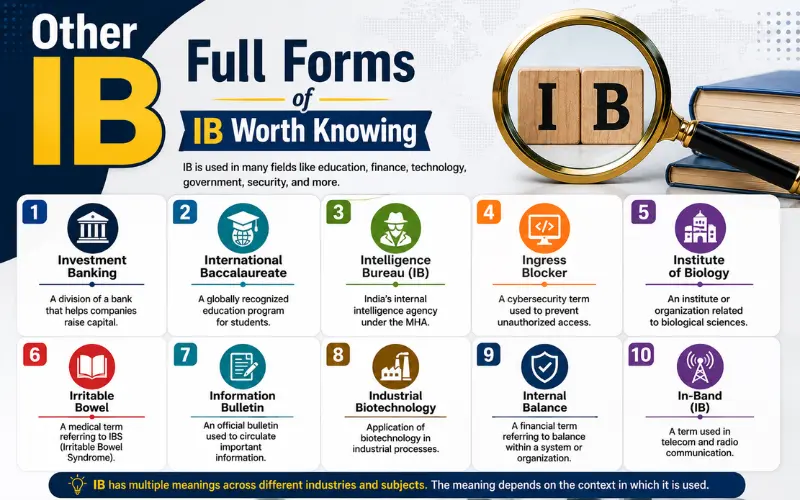
If you are a student, you may already know IB as the International Baccalaureate, an internationally recognized diploma program for students aged 16 to 19. It is governed by the International Baccalaureate Organization (IBO) based in Geneva and accepted by universities worldwide.
In the finance world, IB stands for Investment Banking, the division of a bank that helps corporations raise capital, execute mergers and acquisitions, and manage large-scale financial transactions.
These three meanings, Intelligence Bureau, International Baccalaureate, and Investment Banking, cover about 95% of real-world searches for “IB full form.“
Frequently Asked Questions
What is the full form of IB in the government context?
IB stands for Intelligence Bureau. It is India’s internal intelligence agency under the Ministry of Home Affairs, responsible for domestic security, counterintelligence, and counter-terrorism intelligence.
Is IB the same as RAW?
No. The IB handles internal (domestic) intelligence, while RAW (Research and Analysis Wing) handles external intelligence, operating outside India’s borders. They are separate agencies with separate mandates, reporting structures, and operational jurisdictions.
Does the IB have the power to arrest people?
No. The Intelligence Bureau is purely an intelligence-gathering and analysis organization. It has no statutory arrest powers. Any arrests based on IB intelligence are carried out by the police, CBI, or NIA.
What is the full form of IB in education?
In education, IB stands for International Baccalaureate. It is an internationally recognized school curriculum and diploma program offered in over 150 countries, commonly taken as an alternative to A-levels or standard national boards.
When was the Intelligence Bureau of India founded?
The IB was founded in 1887 by the British colonial government as the “Central Special Branch.” After Indian independence in 1947, it was restructured and renamed the Intelligence Bureau.
Is IB ACIO a good government job?
Yes, IB ACIO is considered one of the more sought-after central government positions. It offers job security, a competitive salary (up to Rs. 1,42,400/month with allowances), career growth opportunities, and the professional prestige of working in national security.
What is the full form of IB in banking or finance?
In banking and finance, IB stands for Investment Banking. An investment bank (or IB division within a bank) helps companies raise funds, go public through IPOs, or execute major corporate transactions like mergers and acquisitions.
Does any law govern the Intelligence Bureau of India?
No specific parliamentary statute governs the IB, which makes it unusual among major government agencies. It operates under executive authority and administrative orders rather than a dedicated IB Act, unlike the NIA (governed by the NIA Act 2008) or the CBI (governed by the DSPE Act 1946).
Final Thought
IB Full Form is much more than just an abbreviation. It represents the Intelligence Bureau, India’s oldest and most important internal intelligence agency, responsible for safeguarding the nation against threats such as terrorism, espionage, cybercrime, and internal security challenges.
Whether you’re preparing for UPSC, SSC, defence exams, or simply trying to understand how India’s security system works, knowing the role of the IB gives you valuable insight into one of the country’s most vital institutions. While IB can also stand for International Baccalaureate or Investment Banking in different contexts, its meaning in the government and national security domain remains the most widely searched and significant.
Understanding the IB Full Form, its history, functions, and career opportunities will help you confidently answer exam questions and appreciate the crucial role the agency plays in protecting India’s internal security.