ITBP Full Form is Indo-Tibetan Border Police. It is India’s dedicated high-altitude border guarding force, operating along the 3,488-km border with China (the Tibet Autonomous Region). Established on 24 October 1962, shortly after the Sino-Indian War, ITBP functions under India’s Ministry of Home Affairs as one of the seven Central Armed Police Forces (CAPFs).
Why the Name Includes “Tibetan” (Not-Chinese)

This trips up a lot of students and first-time readers. When ITBP was formed in 1962, the border India shared with China ran along Tibet, which was then a distinct region with its own political identity. The force was named to reflect the geographical reality of that border, not the political relationship with China.
Today, the border is formally called the Line of Actual Control (LAC), but the ITBP name has stayed. It covers territory across Ladakh, Himachal Pradesh, Uttarakhand, Sikkim, and Arunachal Pradesh, all at elevations that regularly exceed 5,000 meters above sea level.
What ITBP Personnel Actually Do
ITBP jawans operate in terrain where temperatures drop to -45°C. Standard duties include:
- Border patrolling along glaciated mountain passes inaccessible to vehicles
- Anti-infiltration operations to prevent unauthorized crossings
- Disaster response: ITBP teams were among the first responders in the 2013 Kedarnath floods and the 2021 Chamoli glacier burst
- VIP security for senior government officials visiting sensitive border areas
- Escorting diplomatic missions including the annual Kailash Mansarovar Yatra pilgrims
One thing rarely mentioned: ITBP runs free medical camps in remote Himalayan villages that get no other government healthcare access. This is a significant part of their civic mandate.
Key Facts About ITBP at a Glance
| Detail | Information |
| Full Form | Indo-Tibetan Border Police |
| Founded | 24 October 1962 |
| Headquarters | New Delhi |
| Under Ministry | Ministry of Home Affairs, Government of India |
| Active Personnel | 89,432 (as of latest data) |
| Annual Budget | Rs. 11,324.08 crore (2026-27) |
| Border Length Covered | 3,488 km (Indo-China/LAC border) |
How ITBP Differs from Other CAPFs
India has seven Central Armed Police Forces, and students often confuse them. Here is the clearest way to understand ITBP’s unique position:
- BSF (Border Security Force): Guards borders with Pakistan and Bangladesh, primarily in plains terrain.
- SSB (Sashastra Seema Bal): Covers Nepal and Bhutan borders.
- ITBP: Exclusively the China (LAC) border, entirely in high-altitude Himalayan terrain.
ITBP is the only CAPF specifically trained for mountain warfare and high-altitude survival. Their recruits undergo training at altitudes where most people experience severe altitude sickness just walking around.
The 1962 Connection: Why ITBP Was Created
The Sino-Indian War of 1962 exposed a critical gap. India had no specialized force guarding the Himalayan frontier. China crossed into Indian territory with minimal resistance in several sectors.
The government responded by raising ITBP on 24 October 1962, initially with just a handful of battalions drawn from the Central Reserve Police Force (CRPF). The force has since grown to over 89,000 personnel across 60 service battalions, 4 specialised battalions, and 17 training centres.
The Indo-Tibetan Border Police Force Act formally governs the organization. It was enacted in 1992, giving ITBP statutory standing beyond the initial executive order.
ITBP Recruitment: How You Can Join
ITBP recruits at multiple levels. The two most common entry points are:
For officers (Group A Gazetted): Recruitment is through the UPSC CAPF (AC) exam, which selects Assistant Commandants for ITBP along with BSF, CRPF, SSB, and CISF. The exam is conducted annually by the Union Public Service Commission.
For constables and head constables: ITBP conducts its own direct recruitment, advertised on the official website itbpolice.nic.in. Vacancies are posted for roles like General Duty Constable, Tradesman, and Head Constable (Education and Stress Counsellor).
Physical standards are significantly stricter than most central government jobs, given the operational terrain. Candidates must pass a Physical Efficiency Test (PET) and Physical Standard Test (PST) in addition to written exams.
ITBP Battalions and Structure
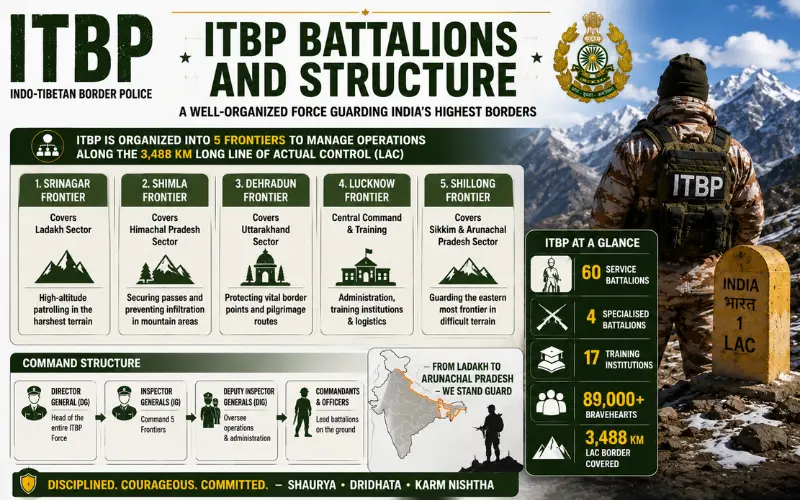
ITBP is organized into five frontiers, each corresponding to a geographic zone along the LAC:
- Srinagar Frontier – Ladakh sector
- Shimla Frontier – Himachal Pradesh sector
- Dehradun Frontier – Uttarakhand sector
- Lucknow Frontier – Central command and training
- Shillong Frontier – Sikkim and Arunachal Pradesh sector
Each frontier is commanded by an Inspector General (IG). The entire force is headed by a Director General (DG), an IPS officer appointed by the Government of India.
FAQ: ITBP Full Form and Related Questions
What is the full form of ITBP?
ITBP stands for Indo-Tibetan Border Police. It is a Central Armed Police Force under India’s Ministry of Home Affairs, responsible for guarding the border with China along the Line of Actual Control.
Is ITBP a military or police force?
ITBP is a paramilitary police force, not a branch of the Indian Army. It is one of India’s seven CAPFs. During wartime or national emergencies, it can be placed under operational command of the armed forces.
Who is the current Director General of ITBP?
As of 2025-26, the Director General is Shatrujeet Singh Kapoor (IPS). The DG is the head of the entire ITBP organization.
Which exam do I need to pass to become an ITBP officer?
You need to clear the UPSC CAPF (Assistant Commandant) exam. It is conducted annually and tests general ability, English, general studies, and elementary mathematics, followed by a physical test and medical examination.
What does ITBP’s motto mean in English?
The motto “Shaurya, Dridhata, Karm Nishtha” translates to “Valour, Steadfastness, and Commitment to Duty.” These three values reflect the extreme discipline and courage required for high-altitude border operations.
Why is ITBP called “Himalayan Guards”?
ITBP personnel are informally known as Himalayan Guards because they are the only Indian security force that operates exclusively in the Himalayan mountain range, patrolling some of the world’s most inhospitable terrain.
Does ITBP guard the Nepal border too?
No. Nepal and Bhutan borders are handled by the SSB (Sashastra Seema Bal). ITBP is exclusively responsible for the Indo-China (LAC) border.
How many battalions does ITBP have?
ITBP has 60 service battalions, 4 specialised battalions, and 17 training institutions, organized under five regional frontiers spanning from Ladakh to Arunachal Pradesh.
Final Thoughts
Understanding the ITBP Full Form is about much more than expanding an abbreviation. The Indo-Tibetan Border Police (ITBP) is India’s specialized high-altitude border guarding force, entrusted with protecting the country’s interests along the challenging Line of Actual Control (LAC) with China. From safeguarding remote Himalayan frontiers and responding to natural disasters to supporting local communities and ensuring the security of important pilgrimages, ITBP plays a vital role in India’s national security.
Whether you’re preparing for competitive exams like UPSC, SSC, CDS, CAPF, or simply looking to understand India’s security forces, knowing ITBP’s history, responsibilities, recruitment process, and unique capabilities provides valuable insight into one of the country’s most respected Central Armed Police Forces.
We hope this guide has answered all your questions about the ITBP Full Form and given you a clear understanding of why the force is known as the “Himalayan Guardians” of India.