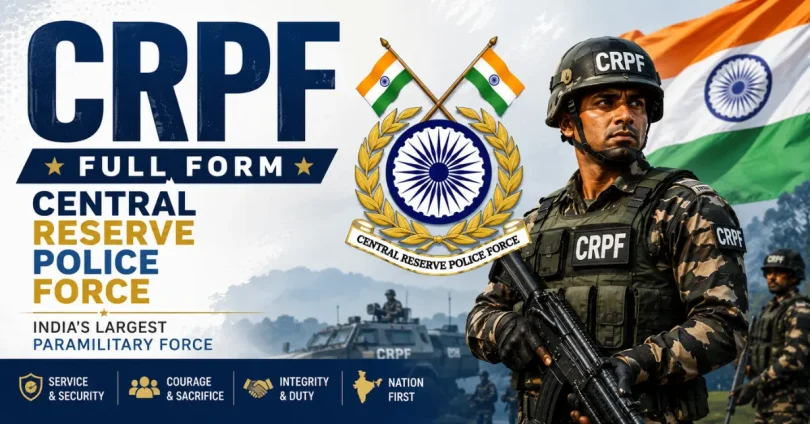

CRPF Full Form stands for Central Reserve Police Force. It is Indias largest central armed police organization, operating under the Ministry of Home Affairs. Founded in 1939 and formally constituted by an Act of Parliament in 1949, the CRPF handles internal security, counter-insurgency, anti-Naxal operations, and election duty across the country. Understanding the CRPF Full Form helps explain the force’s vital role in maintaining law and order and safeguarding national security.
Not Always Called CRPF- The Name Change Most Articles Skip

Here’s something almost every article on this topic skips entirely: CRPF was not always called CRPF.
When it was created on July 27, 1939, the force was named the Crown Representatives Police (CRP). The name reflected the colonial reality of the time. It was set up to assist British-administered princely states in maintaining order, not to serve an independent Indian nation.
After Independence, the name no longer made sense. On December 28, 1949, Parliament passed the CRPF Act, formally renaming it the Central Reserve Police Force and giving it a legal foundation as a national security institution. That 1939 founding date is still observed every year as CRPF Raising Day.
The original mandate was narrow. What it became over eight decades is something far bigger.
What CRPF Actually Does on the Ground
Most “full form” articles describe CRPF in one generic sentence. The reality is much more layered.
Internal Security:
CRPF is deployed wherever state police cannot manage alone. Riots, civil unrest, large-scale disturbances in sensitive states, and post-conflict stabilization all fall within its remit.
Counter-Insurgency in J&K and the Northeast:
CRPF battalions have had a continuous presence in Jammu & Kashmir for decades. They work alongside the Army and state police in some of the country’s most operationally demanding environments.
Anti-Naxal Operations:
The Left Wing Extremism (LWE) belt across Chhattisgarh, Jharkhand, Odisha, and Maharashtra has been CRPF’s primary long-term theatre. This isn’t static guard duty. It involves jungle warfare, IED threat management, and daily contact with hostile terrain.
Election Duty:
Every major state and national election in India involves CRPF deployment at sensitive polling booths. They are the central government’s assurance mechanism when local forces face conflict-of-interest concerns.
Disaster and Flood Relief:
CRPF personnel regularly assist in disaster response, often working alongside NDRF in flood-affected zones across the country.
The Two Elite Units Inside CRPF That Most People Have Never Heard Of
This is the section that separates a real understanding of CRPF from a textbook definition.
RAF– Rapid Action Force
Created in 1992 in response to communal violence in India, the Rapid Action Force is a specialized wing of CRPF trained for riot control and rapid deployment in urban unrest scenarios. It has 15 battalions and is trained specifically to minimize casualties while restoring order fast.
RAF uses non-lethal crowd control measures first. Tear gas, rubber bullets, water cannons, and baton charges precede live ammunition. The training focus is speed and restraint, both at the same time.
COBRA- Commando Battalion for Resolute Action
COBRA is CRPF’s most elite unit, formed in 2009 specifically to fight Maoist (Naxalite) insurgency. The name itself is an acronym: Commando Battalion for Resolute Action.
COBRA personnel go through intensive jungle warfare training. They operate in small teams, deep inside forested Naxal zones where conventional forces struggle to function effectively. COBRA has been credited with multiple significant anti-Naxal operations across the red corridor.
These two units are CRPF’s operational edge. They don’t appear in most “CRPF full form” searches, but they define what the organization is actually capable of.
How CRPF Compares to Other Central Armed Police Forces
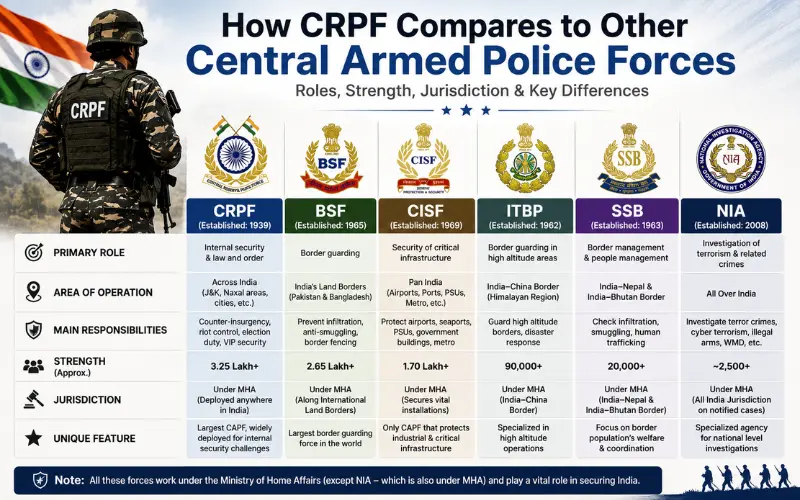
India has several central armed police organizations, and they get confused with each other constantly. Here’s a clean breakdown:
| Force | Full Form | Primary Role |
| CRPF | Central Reserve Police Force | Internal security, counter-insurgency, anti-Naxal |
| BSF | Border Security Force | India-Pakistan and India-Bangladesh borders |
| CISF | Central Industrial Security Force | Airports, industrial assets, nuclear sites |
| ITBP | Indo-Tibetan Border Police | India-China border (Himalayan terrain) |
| SSB | Sashastra Seema Bal | India-Nepal and India-Bhutan borders |
The key distinction: BSF, CISF, ITBP, and SSB each have a defined geographic or sectoral mandate. CRPF is the flexible, deployable force. It goes where other organizations cannot be used, or where the scale of a situation demands a central government response.
CRPF Role in UN Peacekeeping Missions
Very few articles about CRPF mention this, but it matters for a complete picture.
CRPF has contributed personnel to United Nations peacekeeping missions in conflict zones across the world. Indian peacekeepers, including CRPF officers and personnel, have served in missions in Liberia, Haiti, South Sudan, and other UN deployments.
The Formed Police Units (FPUs) sent under the UN flag include CRPF personnel trained in peacekeeping rules of engagement, working under international command alongside forces from dozens of nations. This international dimension doesn’t appear in typical exam-oriented content, but it reflects the professional credibility the force has earned over decades.
Women in CRPF- A History That Goes Back to 1986
CRPF raised the first all-women battalion in India’s central armed police forces in 1986. This wasn’t a token gesture. Women CRPF personnel handle crowd control at sensitive locations, provide security during searches involving female civilians, and serve in conflict areas including J&K and the Northeast.
The Mahila Battalions of CRPF have a distinct operational role, not just symbolic presence. CRPF also fields “Seema Bhawani,” an all-women motorcycle contingent that has represented the force in Republic Day parades and public events. It is a visible symbol of how the organization’s composition has changed since its colonial-era origins.
Joining CRPF- Entry Routes, Ranks, and Pay
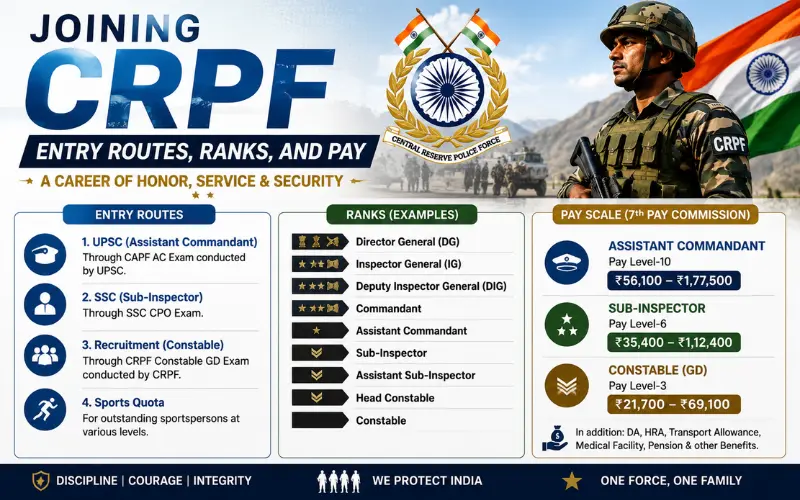
For anyone considering a career with the force, here’s how the structure actually works.
Direct Entry Routes:
- Constable (GD): Through the SSC GD exam. Minimum qualification is Class 10. Age limit is 18-23 years, with relaxations for reserved categories.
- Sub-Inspector (SI): Through the SSC CPO exam. Graduation required.
- Assistant Commandant (AC): Through the UPSC CAPF (AC) exam. The highest direct entry level. Graduation is the minimum qualification.
Pay Scale (7th Pay Commission):
- Constable GD: Rs. 21,700/month basic pay (Level 3)
- Head Constable: Rs. 25,500/month (Level 4)
- Sub-Inspector: Rs. 35,400/month (Level 6)
- Inspector: Rs. 44,900/month (Level 7)
- Assistant Commandant: Rs. 56,100/month (Level 10)
All ranks receive additional allowances on top of basic pay. These include House Rent Allowance (HRA), ration money, transport allowance, and a risk/hardship allowance for field postings. Personnel deployed in conflict zones or high-altitude areas get further field area allowances.
Promotion Path: Constable to Head Constable to ASI to SI to Inspector, then to Group B and Group A gazetted ranks through departmental promotion exams and service record evaluation
FAQ- CRPF Full Form and Related Questions
What is the full form of CRPF?
CRPF stands for Central Reserve Police Force. It is India’s largest central armed police organization, functioning under the Ministry of Home Affairs.
When was CRPF established?
CRPF was established on July 27, 1939, originally under the name Crown Representatives Police. It was formally renamed and constituted under the CRPF Act on December 28, 1949.
What was CRPF called before Indian Independence?
Before Independence, it was called the Crown Representatives Police (CRP). The British set it up to help princely states maintain internal order. The name changed when India became a republic and the CRPF Act was enacted in 1949.
Is CRPF part of the Indian Army?
No. CRPF is not part of the Indian Army. It is a central armed police force under the Ministry of Home Affairs. The Army operates under the Ministry of Defence. They have entirely separate command structures, mandates, and legal frameworks.
What does COBRA stand for in CRPF?
COBRA stands for Commando Battalion for Resolute Action. It is CRPF’s elite jungle warfare unit, formed in 2009 to conduct counter-Naxal operations in India’s Left Wing Extremism-affected states.
What is CRPF’s role during elections in India?
CRPF is deployed at sensitive polling booths during state and national elections. The central government uses it to ensure free and fair voting in areas where local police credibility is in question or security threats are elevated.
How large is CRPF?
CRPF has over 3 lakh (300,000) personnel spread across more than 200 battalions. That makes it one of the largest paramilitary forces in the world, larger than the standing armies of many nations.
Can women join CRPF, and in what roles?
Yes. Women can join as constables, sub-inspectors, and in other ranks through standard recruitment exams. CRPF raised India’s first all-women central police battalion in 1986 and continues to recruit women across multiple entry categories, including operational field roles.
Final Thought
CRPF Full Form is much more than just the expansion of an abbreviation it represents one of India’s most trusted and versatile security forces. From maintaining internal law and order and conducting anti-Naxal operations to protecting elections and serving in United Nations peacekeeping missions, the Central Reserve Police Force plays a vital role in safeguarding the nation.
Whether you’re preparing for SSC, UPSC, defence recruitment exams, or simply expanding your general knowledge, understanding the CRPF Full Form, its history, responsibilities, and career opportunities provides valuable insight into one of India’s most important central armed police forces.