
What Is the UPSC Full Form?
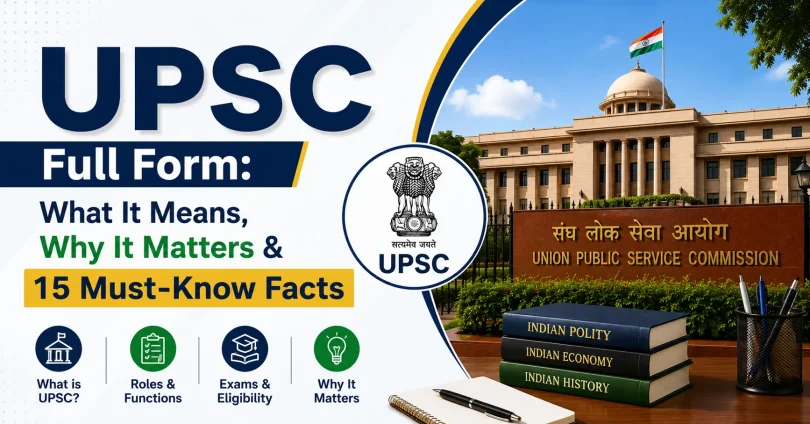
UPSC stands for Union Public Service Commission.
UPSC Full Form refers to the Union Public Service Commission, India’s premier central recruiting authority responsible for selecting candidates for the country’s most prestigious government positions. If you have ever heard someone say they are “preparing for UPSC,” they almost certainly mean they are working toward the Civil Services Examination, which is India’s toughest and most competitive exam.
The UPSC is a constitutional body, established under Article 315 of the Indian Constitution. This means it was created by the Constitution itself, not by an ordinary law, which gives it independence and authority over the recruitment process for central government services.
UPSC: A Quick Overview
| Detail | Information |
|---|---|
| Full Form | Union Public Service Commission |
| Type | Constitutional Body |
| Established | October 1, 1926 (as Public Service Commission); January 26, 1950 (renamed UPSC) |
| Constitutional Basis | Articles 315 to 323 of the Indian Constitution |
| Headquarters | Dholpur House, Shahjahan Road, New Delhi |
| Official Website | www.upsc.gov.in |
| Chairperson (Current) | Appointed by the President of India |
| Key Exam | Civil Services Examination (CSE), popularly called the IAS exam |
The History of UPSC: From British India to the Republic
Understanding UPSC’s origin helps you appreciate how central it is to India’s governance structure.
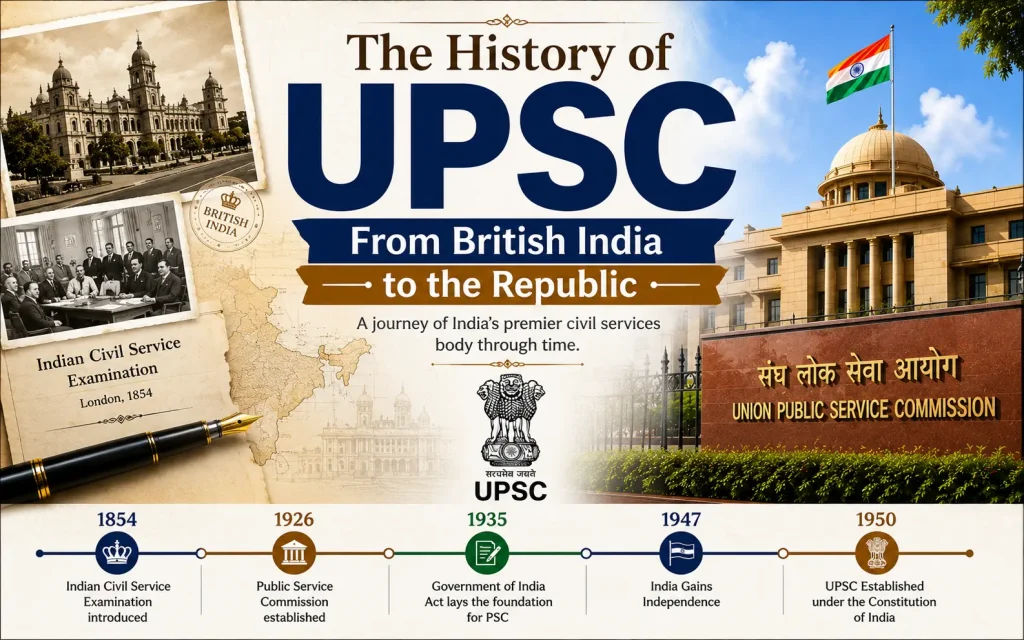
1854: The British East India Company introduced the concept of a civil services examination. However, these exams were held only in London, making it nearly impossible for Indians to appear.
1864: Shri Satyendranath Tagore, brother of the legendary poet Rabindranath Tagore, became the first Indian to clear the Indian Civil Services exam. This was a landmark moment.
Post-Montagu-Chelmsford Reforms (1919): Civil service exams began to be held in India, opening the door for more Indian candidates.
October 1, 1926: The Public Service Commission was set up in India for the very first time. Sir Ross Barker, a member of the Home Civil Service of the United Kingdom, served as its first Chairman.
January 26, 1950: When India adopted its Constitution, the Federal Public Service Commission was formally renamed the Union Public Service Commission (UPSC). This date, India’s Republic Day, is when the UPSC as we know it today came into existence.
The UPSC has evolved over decades into a robust, transparent, and constitutionally protected institution.
What Does UPSC Actually Do? (Its Core Functions)
Many people associate UPSC only with the IAS exam. In reality, the Commission performs a wide range of functions under Article 320 of the Indian Constitution.
Here is what UPSC does:
- Conduct Recruitment Examinations UPSC conducts multiple competitive exams each year to select officers for All India Services, Central Services (Group A and Group B), and Defence Services.
- Frame and Amend Recruitment Rules It advises the government on the rules for recruitment to various central government posts, ensuring fairness and merit-based selection.
- Advise on Promotions and Transfers UPSC is consulted when civil servants are promoted to higher grades or transferred between services.
- Handle Disciplinary Matters The Commission advises the government on disciplinary actions, including dismissals, removals, and reductions in rank of civil servants.
- Conduct Departmental Exams UPSC also conducts departmental tests and examinations for in-service government employees.
- Review Service Conditions It recommends changes to the pay, service conditions, and allowances of civil servants when consulted by the government.
All Examinations Conducted by UPSC
UPSC does not conduct just one exam. It runs over a dozen examinations every year, covering civil, defence, engineering, and scientific roles.
Civil Services and Administrative Exams
Civil Services Examination (CSE): The most famous UPSC exam. Selects candidates for services including IAS, IPS, IFS (Indian Foreign Service), IRS, and over 20 other Group A and Group B services.
Indian Forest Service Examination (IFoS): Selects officers for the Indian Forest Service.
Combined Defence Services Examination (CDS): For entry into the Indian Army, Navy, and Air Force (Officer cadre).
National Defence Academy and Naval Academy Examination (NDA/NA): For Class 12 pass students seeking to join the armed forces as officers.
Engineering and Technical Exams
Engineering Services Examination (ESE/IES): For recruitment to technical posts in government departments like Railways, Telecom, and Public Works.
Combined Geo-Scientist Examination: For posts like Geologist, Geophysicist, and Chemist in the Ministry of Mines.
Specialised and Other Exams
Central Armed Police Forces (CAPF) Examination: For the post of Assistant Commandant in forces like BSF, CRPF, CISF, ITBP, and SSB.
Special Class Railway Apprentice Exam (SCRA)
Indian Statistical Service (ISS) and Indian Economic Service (IES) Examination
Combined Medical Services Examination
This shows that UPSC is not just the “IAS body.” It is the central gateway for dozens of prestigious government careers in India.
UPSC Civil Services Exam: How It Works
The UPSC Civil Services Examination (CSE) is conducted in three stages. Each stage filters candidates, and only the best make it through to the final list.
Stage 1: Preliminary Examination (Prelims)
Two objective-type papers: General Studies Paper 1 and General Studies Paper 2 (CSAT)
Paper 2 (CSAT) is qualifying in nature; you need 33% to pass it
Paper 1 marks are used for shortlisting to Mains
Negative marking: 1/3 mark deducted for each wrong answer
Stage 2: Main Examination (Mains)
Nine descriptive papers in total
Four GS papers, one Essay paper, two Optional Subject papers, and two language papers (qualifying)
Total marks: 1,750 (used for final merit)
Tests depth of knowledge, analytical thinking, and writing ability
Stage 3: Personality Test (Interview)
Conducted by the UPSC Board
Maximum marks: 275
Tests personality, leadership qualities, communication, and awareness
Not a test of knowledge alone, but of overall suitability for civil services
Final Merit: Marks from Mains + Interview = Final ranking. Prelims marks are not counted.
Services You Can Join Through UPSC CSE
Clearing the UPSC Civil Services Exam can open the door to over 20 different central government services. The most sought-after ones are:
| Service | Full Form | Work Area |
|---|---|---|
| IAS | Indian Administrative Service | District and state administration |
| IPS | Indian Police Service | Law enforcement and policing |
| IFS | Indian Foreign Service | Diplomacy and foreign affairs |
| IRS (IT) | Indian Revenue Service (Income Tax) | Tax administration |
| IRS (C&IT) | Indian Revenue Service (Customs & IT) | Customs and indirect taxes |
| IRTS | Indian Railway Traffic Service | Railway management |
| IDAS | Indian Defence Accounts Service | Defence finance |
| IAAS | Indian Audit and Accounts Service | Government auditing |
Rank and preference in the form, along with the number of vacancies per service, determines which service a candidate ultimately joins.
UPSC Eligibility Criteria: Who Can Apply?
Before you begin preparation, confirm that you meet the basic eligibility requirements.
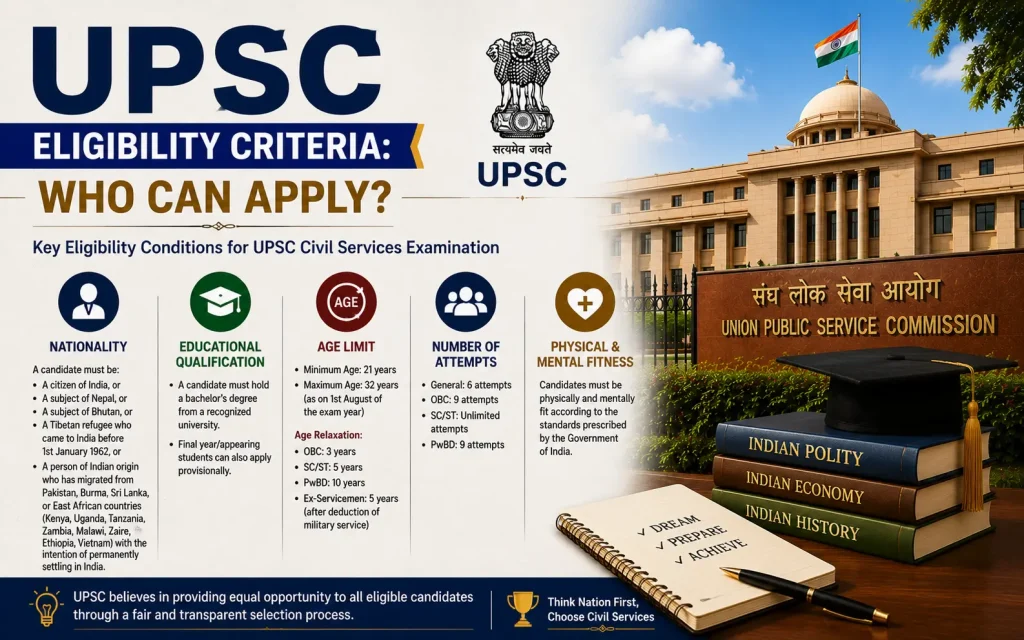
Nationality
Must be a citizen of India (for most services)
Candidates from Nepal, Bhutan, and certain other countries may apply for specific services
Educational Qualification
Must hold a degree from a recognized university
Final year students can also apply (subject to producing the degree before Mains)
Age Limit
| Category | Minimum Age | Maximum Age | Number of Attempts |
|---|---|---|---|
| General (Unreserved) | 21 years | 32 years | 6 |
| OBC | 21 years | 35 years | 9 |
| SC/ST | 21 years | 37 years | Unlimited (till age limit) |
| PwBD (General) | 21 years | 42 years | 9 |
| Ex-Servicemen (General) | 21 years | Up to 37 years | As per rules |
Important note: Age is calculated as of August 1 of the exam year.
UPSC vs State PSC: What Is the Difference?
A very common point of confusion, especially for first-time aspirants, is the difference between UPSC and State PSCs (Public Service Commissions).
| Feature | UPSC | State PSC |
|---|---|---|
| Level | Central Government | State Government |
| Key Exam | Civil Services Exam (IAS, IPS, etc.) | PCS, HCS, MPSC, TNPSC, etc. |
| Jurisdiction | All India and Central Services | State cadre services only |
| Constitutional Basis | Article 315 of the Constitution | Article 315 (for states) |
| Posting | Anywhere in India (and abroad for IFS) | Mostly within the respective state |
| Exam Difficulty | Highest in India | Slightly lower, but still competitive |
Both are equally important depending on your career goal. UPSC selects for pan-India service, while State PSCs recruit for state-level administration.
UPSC Exam Calendar: Key Dates to Know
UPSC releases an annual exam calendar at the beginning of each year. Here is a general idea of when key exams are held:
| Exam | Notification (Approx.) | Prelims/Exam (Approx.) |
|---|---|---|
| Civil Services (Prelims) | February | May/June |
| Civil Services (Mains) | After Prelims result | September/October |
| Engineering Services (ESE) | September | January (next year) |
| CAPF Examination | April/May | August |
| NDA/NA | December and June | April and September |
| CDS | October and June | February and November |
Always check the official UPSC website (upsc.gov.in) for the latest and most accurate dates.
Why Is UPSC Called India’s Toughest Exam?
The Civil Services Examination consistently receives over 1 million applications every year. Out of these, roughly:
Around 5 lakh candidates actually appear for Prelims
Only about 10,000-15,000 qualify for Mains
Around 2,000-2,500 appear in the interview
Typically, 700-1,000 candidates receive final selections
The selection rate is less than 0.1% of all applicants. The exam demands two to three years of consistent, structured preparation across a vast syllabus covering History, Geography, Polity, Economics, Science and Technology, Environment, Current Affairs, Ethics, and an optional subject.
Salary and Perks After Clearing UPSC
One reason UPSC remains so aspirational is the combination of authority, responsibility, and benefits that come with civil service posts.
Here is a general salary structure under the 7th Pay Commission:
| Service | Pay Level | Basic Pay (Approx.) |
|---|---|---|
| IAS/IPS/IFS (Entry) | Level 10 | Rs. 56,100/month |
| Joint Secretary level | Level 14 | Rs. 1,44,200/month |
| Secretary/DG level | Level 17 | Rs. 2,25,000/month |
Beyond salary, civil servants receive allowances (DA, HRA, TA), government accommodation, medical facilities, security, and other benefits. IFS officers also get foreign allowances and diplomatic perks.
5 Common Myths About UPSC, Debunked
Myth 1: “Only Arts students can clear UPSC.” False. Engineers, doctors, scientists, and commerce graduates have topped the UPSC exam. The exam tests thinking, not just subject knowledge.
Myth 2: “You need coaching to clear UPSC.” Many toppers have cleared the exam through self-study. Coaching can help with structure and guidance, but it is not mandatory.
Myth 3: “UPSC is only for young people.” The upper age limit for general category candidates is 32. That gives working professionals years to prepare alongside their jobs.
Myth 4: “You must know everything.” UPSC rewards depth of understanding over breadth of rote knowledge. Quality study matters more than reading hundreds of books.
Myth 5: “Failing once means you should quit.” Most successful candidates clear the exam on their second, third, or later attempt. Persistence and honest self-evaluation are key.
How to Start Your UPSC Preparation: Practical First Steps
If you are just getting started, here is a clear roadmap:
- Read the official UPSC syllabus. Download it from upsc.gov.in. This is your North Star.
- Start with NCERT textbooks. Classes 6 to 12 NCERTs in History, Geography, Polity, Economics, and Science build the foundation.
- Choose your optional subject wisely. Pick something you genuinely enjoy and have studied before.
- Read one national newspaper daily. The Hindu or Indian Express are recommended.
- Solve previous year question papers. UPSC repeats themes (not exact questions), so past papers reveal the pattern.
- Practice answer writing from day one. Mains is entirely descriptive. Writing regularly from the start sharpens your ability.
- Stay consistent, not just intense. A steady two to three hours of focused daily study outperforms occasional ten-hour cramming sessions.
Constitutional Backing: Why UPSC Is Independent
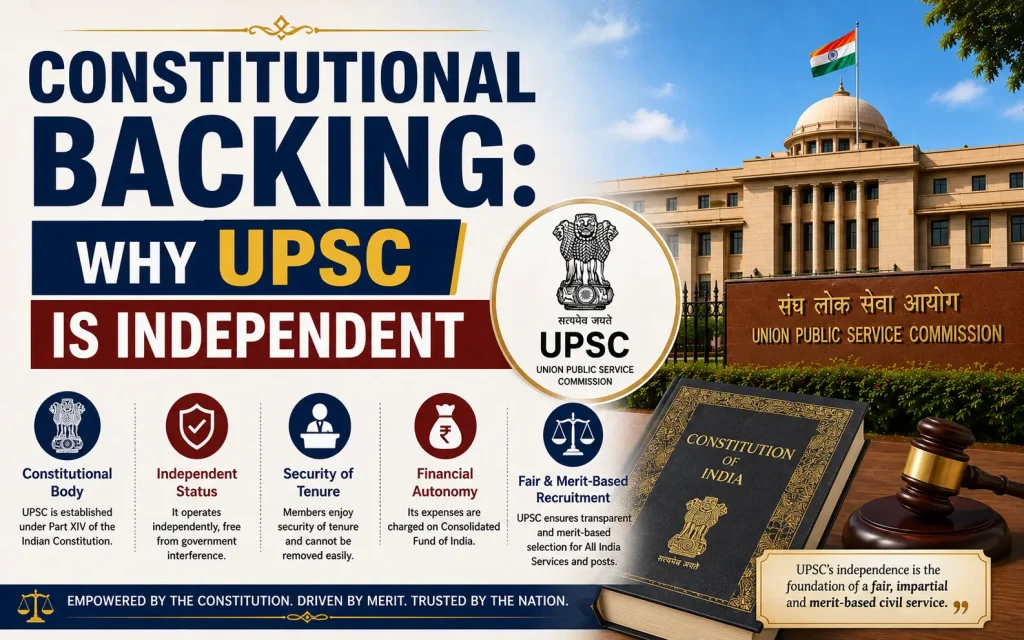
Unlike many regulatory bodies, UPSC is directly embedded in the Constitution of India under Articles 315 to 323. This gives it a unique status:
- The Chairman and Members of UPSC are appointed by the President of India, not by any political party or minister.
- They can only be removed by a presidential order following a Supreme Court inquiry, protecting them from political pressure.
- Their service conditions cannot be varied to their disadvantage after appointment.
- This constitutional protection ensures that UPSC remains impartial and merit-based, free from government interference in its day-to-day functioning.
Frequently Asked Questions (FAQs)
FAQs
. What is the UPSC full form? UPSC stands for Union Public Service Commission.
When was UPSC established? The Public Service Commission was first set up on October 1, 1926. It was renamed the Union Public Service Commission on January 26, 1950, when the Indian Constitution came into effect.
Which article of the Indian Constitution established UPSC?
UPSC is established under Article 315 of the Constitution. Its functions are detailed in Articles 315 to 323.
What is the most popular exam conducted by UPSC?
The Civil Services Examination (CSE), commonly known as the IAS exam, is the most popular and competitive exam conducted by UPSC.
How many attempts does a general category candidate get for UPSC?
A general category candidate gets six attempts between the ages of 21 and 32 years.
Conclusion
UPSC, the Union Public Service Commission, is far more than just an exam body. It is the constitutional backbone of India’s merit-based civil services system, responsible for identifying and recruiting the men and women who will govern the country, protect its borders, manage its forests, and represent it on the world stage.
Whether you are a student just discovering UPSC or an aspirant already knee-deep in preparation, understanding the full scope of what UPSC does, what it stands for, and what it can lead to, gives you a sharper sense of purpose.
The journey is demanding. But for those who commit to it, clearing UPSC is one of the most rewarding professional achievements possible in India.
You May Also Like It:
DEO Full Form in English and Hindi