
CBI Full Form is one of the most searched law enforcement terms in India. If you have ever watched a news report about a high-profile corruption case or a sensitive criminal investigation in India, you have almost certainly heard the name “CBI.” But what does CBI actually stand for, how does it work, and why does it matter? This guide answers every important question in one place.
What Is the Full Form of CBI
CBI stands for Central Bureau of Investigation.
CBI Full Form refers to India’s premier federal law enforcement and investigation agency. The CBI investigates serious crimes including corruption by government officials, economic offences, major fraud cases, and crimes of national and international importance. Many CBI Full Form blogs provide detailed explanations of its powers, functions, and jurisdiction.
The CBI operates under the Department of Personnel and Training (DoPT), which falls under the Prime Minister’s Office. It is headquartered in New Delhi.
| Detail | Information |
|---|---|
| Full Form | Central Bureau of Investigation |
| Motto | Industry, Impartiality, Integrity |
| Established | 1963 |
| Legal Basis | Delhi Special Police Establishment Act, 1946 |
| Headquarters | New Delhi, India |
| Parent Department | Department of Personnel and Training (DoPT) |
| Annual Budget (2026–27) | Rs. 1,104.98 crore |
| Total Strength | Approx. 6,391 officers |
| Website | cbi.gov.in |
CBI Full Form in Hindi
CBI का पूरा नाम है केंद्रीय जांच ब्यूरो (Kendriya Janch Bureau). यह भारत की सबसे प्रमुख जांच एजेंसी है, जो भ्रष्टाचार, आर्थिक अपराध और संवेदनशील आपराधिक मामलों की जांच करती है।
History of the CBI: How Did It Start?
The story of the CBI begins during World War II, not in 1963 as many people assume.
1941: The British Government set up the Special Police Establishment (SPE) to investigate cases of bribery and corruption involving war-time purchases and procurement.
1946: After India’s independence was approaching, the SPE was placed on a statutory footing through the Delhi Special Police Establishment Act, 1946. This act remains the legal backbone of the CBI even today.
1963: The Government of India formally established the Central Bureau of Investigation on April 1, 1963, through a Home Ministry resolution. The CBI absorbed the Delhi Special Police Establishment and took on a much wider mandate.
1965: The CBI was further empowered to investigate crimes under the Prevention of Corruption Act and economic offences involving central government employees.
Over the decades, the CBI has handled some of the most complex and sensitive investigations in India’s history, from the 1984 anti-Sikh riots cases to the Bofors scandal, Vyapam scam, and coal allocation scam.
The Motto of the CBI: What It Stands For
The CBI operates by a three-word motto: “Industry, Impartiality, Integrity.”
These three words define the agency’s working philosophy:
- Industry means working hard and diligently on every investigation without shortcuts.
- Impartiality means treating every case and every person with fairness, regardless of political influence or social status.
- Integrity means maintaining honesty and ethical standards in every action.
- This motto is especially significant because the CBI is often called upon to handle cases where political pressure is intense. The motto reminds the agency of its duty to remain independent.
Structure of the CBI: How Is It Organised
CBI Full Form organization is large and highly structured, with specialized branches dedicated to different types of investigations. Understanding its structure helps you understand why it is so effective at handling complex cases.
The Director
The Director of the CBI is the head of the agency. The Director is an officer of the Indian Police Service (IPS) and is appointed for a fixed tenure of two years to ensure independence from political influence.
The appointment is made by a high-powered committee consisting of:
- The Prime Minister (Chairperson)
- The Leader of the Opposition in the Lok Sabha
- The Chief Justice of India (or a Supreme Court Judge nominated by the CJI)
This committee-based selection process was introduced by the Lokpal and Lokayuktas Act, 2013 to make the appointment more transparent and less politically influenced.
Major Divisions of the CBI
The CBI is divided into several specialised branches, each with a specific focus area:
- Anti-Corruption Branch (ACB) This is the most well-known division. It investigates corruption cases involving central government employees, public sector undertakings, and cases referred by the Supreme Court or High Courts.
- Economic Offences Wing (EOW) This division handles cases related to financial crimes, bank fraud, securities fraud, import-export violations, and other economic offences that have a significant national impact.
- Special Crimes Branch (SCB) This branch investigates serious crimes such as murder, kidnapping, bomb blasts, and organised crime cases when the scale or sensitivity demands central investigation.
- Bank Securities and Fraud Cell (BSFC) Specialised for investigating large-scale bank frauds and financial scams. The Nirav Modi and Mehul Choksi cases were handled under this category.
- Interpol Wing The CBI serves as India’s liaison with Interpol, the international police organisation. It coordinates with foreign law enforcement agencies for extradition requests, tracking of fugitives abroad, and international criminal cooperation.
- Legal and Technical Divisions These provide internal legal support, forensic assistance, and technical expertise to active investigation teams.
Functions and Powers of the CBI

The CBI is not just an investigation agency. It plays a broader role in India’s law enforcement ecosystem.
Core Functions
- Investigating cases of corruption involving central government employees
- Investigating economic crimes with interstate or international dimensions
- Handling sensitive cases referred by the Supreme Court and High Courts
- Investigating cases referred by state governments (with prior consent)
- Coordinating with Interpol for cross-border criminal matters
- Maintaining crime statistics and intelligence on criminal trends
Special Powers
- The CBI can file cases and charge-sheets directly in special CBI courts
- It can arrest suspects in cases registered under the Delhi Special Police Establishment Act
- The CBI has the power to take over a case from state police if the central government or a court directs it to do so
- It can operate across all states without seeking separate permission in states where general consent is already given
The Consent Requirement: A Critical Limitation
One of the most misunderstood aspects of the CBI is its jurisdiction. Unlike state police, the CBI cannot simply walk into any state and start investigating.
Under the Delhi Special Police Establishment Act, the CBI requires the consent of the state government before it can investigate cases within that state’s territory.
There are two types of consent:
General Consent: A state gives blanket permission to the CBI to investigate cases within its territory. Most states maintain general consent.
Specific Consent: Some states have withdrawn general consent. In such states, the CBI can only investigate a specific case after the state government provides written permission for that particular case.
As of recent years, several states including Maharashtra, West Bengal, Rajasthan, Jharkhand, Chhattisgarh, Kerala, and Mizoram have withdrawn general consent to the CBI. This means the CBI cannot investigate fresh cases in these states without specific permission.
Exception: Even without state consent, the CBI can investigate a case if a High Court or the Supreme Court of India orders it to do so. Courts frequently use this power in cases where the state police is suspected of bias or inaction.
CBI vs State Police: Key Differences
Many people wonder why cases are handed to the CBI when state police already exists. Here is a clear comparison:
| Feature | CBI | State Police |
|---|---|---|
| Jurisdiction | Pan-India (with consent) | Within the state |
| Handles Cases | Central government employees, economic crimes, court-referred cases | All categories of crime within the state |
| Under Control Of | Central Government (DoPT) | State Government |
| Perceived Independence | Higher in sensitive political cases | Can face political pressure from the state government |
| Court Referrals | Frequently directed by the Supreme Court and High Courts | Rarely directed by courts unless local failure |
| International Coordination | Yes (via Interpol) | Limited |
| Specialisation | Corruption, fraud, serious organised crime | General policing |
CBI vs ED vs NIA: What Is the Difference
India has three major central investigation agencies that often appear in the same headlines but have completely different mandates. Here is how they differ:
| Feature | CBI | ED (Enforcement Directorate) | NIA (National Investigation Agency) |
|---|---|---|---|
| Full Form | Central Bureau of Investigation | Enforcement Directorate | National Investigation Agency |
| Primary Focus | Corruption, fraud, serious crime | Money laundering, foreign exchange violations | Terrorism, national security threats |
| Parent Ministry | DoPT (PMO) | Ministry of Finance | Ministry of Home Affairs |
| Key Laws Used | DSPE Act, Prevention of Corruption Act | PMLA, FEMA | NIA Act, UAPA |
| Established | 1963 | 1956 | 2008 (after the 26/11 Mumbai attacks) |
| Handles Terror Cases | No | Only financial links | Yes |
The three agencies often work the same high-profile cases from different angles. For example, in a terror financing case, the NIA investigates the attack, the ED investigates the money trail, and the CBI may investigate related public servant involvement.
How Does a Case Reach the CBI
Not every case gets handed to the CBI. There are four specific routes through which a case comes under CBI jurisdiction:
- Self-Initiated Cases The CBI can register cases on its own when they involve central government employees or fall under its defined mandate.
- Central Government Reference The central government can direct the CBI to investigate a case involving a public servant or a matter of national importance.
- State Government Request A state government can request the CBI to take over a case. Once the CBI accepts, it proceeds with the investigation.
- Court Order The Supreme Court or any High Court can direct the CBI to investigate a case, especially when:
- There is suspicion of state police bias
- The case has interstate dimensions
- The case involves a public official and the state may be compromised
- Public interest demands an independent probe
Notable Cases Investigated by the CBI
The CBI has handled some of India’s most complex and high-profile investigations. Here are a few significant ones:
- Bofors Scandal (1987): Alleged kickbacks in the purchase of Bofors howitzers for the Indian Army
- Hawala Scandal (1991): Hawala money transactions linked to politicians and bureaucrats
- Fodder Scam (1996): Large-scale embezzlement of government funds in Bihar
- 2G Spectrum Scam (2008): Irregular allocation of telecom spectrum, causing alleged loss to the exchequer
- Coal Allocation Scam (2012): Irregularities in the allocation of coal blocks
- Vyapam Scam (2013): Madhya Pradesh’s professional examination fraud involving hundreds of officials
- Nirav Modi – PNB Bank Fraud (2018): Rs. 13,500 crore fraud involving Punjab National Bank
- Sushant Singh Rajput Case (2020): Actor’s death investigated after public demand and Supreme Court direction
Who Can Join the CBI
The CBI recruits officers through multiple channels:
- Direct Recruitment Sub-Inspector posts are filled through direct recruitment examination conducted by the CBI itself.
- Deputation Most CBI officers, especially at senior levels, come on deputation from state police services, the IPS, and other central services.
- Staff Selection Commission (SSC) Certain technical and support roles are filled through SSC examinations.
- IPS Officers Senior positions including the Director, Joint Directors, and Deputy Inspectors General are filled by IPS officers either on deputation or through promotion.
Criticism and Controversies Surrounding the CBI
- No article about the CBI would be complete without acknowledging the criticisms it faces. Several committees and courts have questioned its functioning over the years.
- “Caged Parrot” Remark In 2013, the Supreme Court of India described the CBI as a “caged parrot speaking in its master’s voice,” raising serious concerns about its autonomy and political influence over investigations.
- Selective Investigation Critics argue that the CBI is sometimes used as a tool to target political opponents while protecting allies of the ruling government.
- Staff Shortage The agency has a significant vacancy gap. Against a sanctioned strength of 7,274, it operates with only about 6,391 officers, affecting its capacity to handle the growing caseload.
- Slow Trials Many CBI cases take years or even decades to conclude in special CBI courts, leading to concerns about delayed justice.
- State Consent Battles The withdrawal of general consent by multiple states has created legal disputes and slowed down investigations that cross state boundaries.
- Despite these criticisms, the CBI remains India’s most recognised and trusted investigation brand, especially in the public mind. Courts continue to order CBI probes precisely because it is seen as more independent than state agencies in politically sensitive matters.
Other Full Forms of CBI
The abbreviation CBI appears in other contexts as well. Here is a quick reference:
| Full Form | Field |
|---|---|
| Central Bureau of Investigation | Indian Law Enforcement |
| Confederation of British Industry | UK Business Organisation |
| California Bureau of Investigation | USA State Law Enforcement |
| Cumulative Bounce Index | Cricket Statistics |
| Core Banking Infrastructure | Banking and Finance |
In Indian contexts, CBI always refers to the Central Bureau of Investigation unless otherwise specified.
CBI at a Glance: Quick Facts
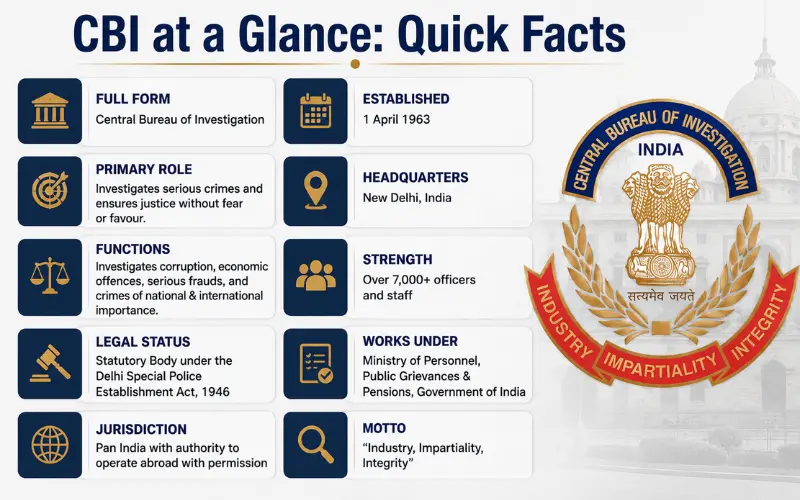
- CBI was established on April 1, 1963
- It derives its powers from the Delhi Special Police Establishment Act, 1946
- The CBI motto is Industry, Impartiality, Integrity
- The Director is appointed for a fixed two-year tenure
- The CBI requires state consent to investigate cases in most states
- It is India’s nodal agency for Interpol coordination
- The CBI has its own special courts for trials
- The annual budget for 2026-27 is approximately Rs. 1,104.98 crore
- India’s CBI is distinct from any US or UK agency of the same initials
Frequently Asked Questions About CBI Full Form
What is the full form of CBI?
CBI stands for Central Bureau of Investigation. It is India’s top federal investigation agency, operating under the Department of Personnel and Training.
When was the CBI established?
The CBI was formally established on April 1, 1963, through a resolution of the Government of India’s Home Ministry. However, its legal foundation is the Delhi Special Police Establishment Act of 1946.
What is the motto of the CBI?
The CBI’s motto is “Industry, Impartiality, Integrity.” It reflects the agency’s commitment to hard work, fairness, and ethical conduct.
Who is the head of the CBI?
The head of the CBI is called the Director. The Director is an IPS officer appointed for a fixed two-year term by a high-powered committee that includes the Prime Minister, Leader of the Opposition, and the Chief Justice of India.
Can the CBI investigate any case in any state?
The CBI requires the consent of the state government before it can investigate cases within that state. However, courts like the Supreme Court or High Courts can direct the CBI to investigate even without state consent.
Which states have withdrawn consent to the CBI?
As of recent reports, states including West Bengal, Maharashtra, Kerala, Rajasthan, Jharkhand, Chhattisgarh, and Mizoram have withdrawn general consent to the CBI.
What is the difference between CBI and ED?
The CBI investigates corruption, fraud, and serious crimes. The ED (Enforcement Directorate) specifically handles money laundering and violations of foreign exchange laws. The two agencies often work related aspects of the same high-profile case.
Final Thoughts
The CBI is far more than just a name that appears in newspaper headlines. It is a complex, specialised institution that serves as a check on corruption, financial crime, and serious offences that cross state boundaries or involve powerful individuals.
The CBI is a large and structured organisation with specialised branches. Understanding its structure helps you understand why CBI Full Form is associated with some of India’s most complex and high-profile investigations..
For the most current information, always refer to the official CBI website at cbi.gov.in.
You May Also Like It:
Railway NTPC Full Form in Hindi