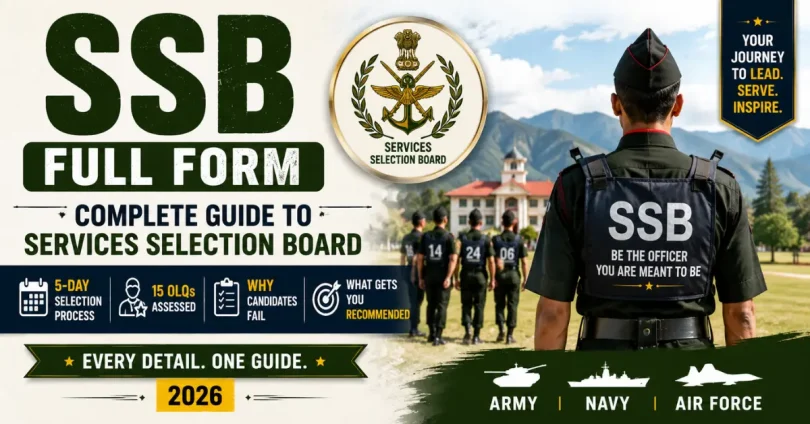

SSB Full Form is Services Selection Board. It is the official body that evaluates candidates for officer positions in the Indian Army, Indian Navy, and Indian Air Force through a rigorous five-day selection process. Every commissioned officer in the Indian Armed Forces, regardless of their entry scheme, must clear the SSB before joining any military academy.
Wait There Are Two “SSBs” in India
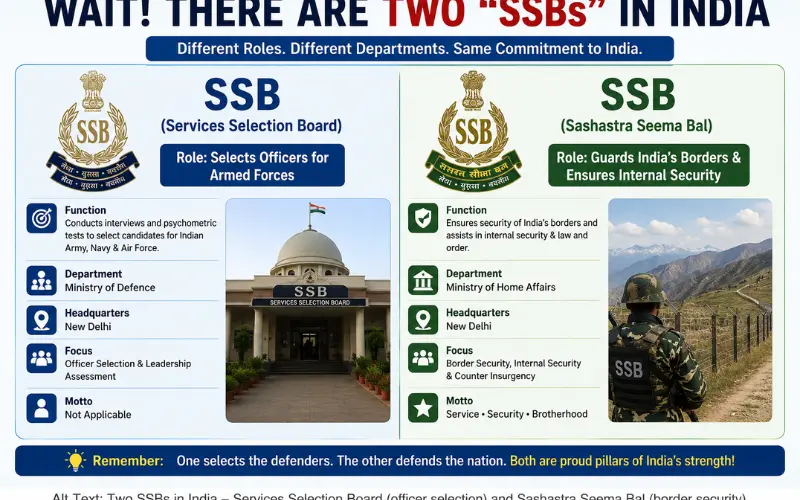
SSB has two entirely different full forms in the Indian context:
- Services Selection Board: The five-day interview and assessment process for Indian Armed Forces officer selection. This is what most people searching “SSB full form” are looking for.
- Sashastra Seema Bal: A Central Armed Police Force (CAPF) under the Ministry of Home Affairs that guards India’s borders with Nepal and Bhutan. Completely different organization, same abbreviation.
If you are a defence aspirant preparing for NDA, CDS, or AFCAT, you mean the first one. If you are preparing for CAPF exams, you likely mean the second. This guide covers the Services Selection Board in full detail.
What the Services Selection Board Actually Is
The SSB is not an exam. That distinction matters.
Most written exams measure what you know. The SSB measures who you are. The board uses a standardized scientific evaluation system developed from the British War Office Selection Board (WOSB) model used during World War II to quickly identify officer potential. India adapted this system post-independence and has refined it over decades.
At its core, the board evaluates one thing: Officer-Like Qualities (OLQs). There are 15 of them, and they form the backbone of every test, every group task, and every interview conducted during the five days
The 15 Officer-Like Qualities (OLQs) Every Aspirant Must Know
No competitor article lists all 15 OLQs with practical context. Here they are:
Cluster 1: Reasoning Ability
- Effective Intelligence: Applying common sense and logical thinking in real situations, not just academic intelligence.
- Reasoning Ability: Capacity to draw correct conclusions from given data.
Cluster 2: Social Adaptability
- Power of Expression: Communicating clearly under pressure, both verbally and in writing.
- Cooperativeness: Working with others without ego or friction.
- Sense of Responsibility: Taking ownership of tasks and their outcomes.
Cluster 3: Social Effectiveness
- Social Adaptability: Adjusting quickly to new people and environments.
- Speed of Decision: Making timely decisions even with incomplete information.
- Ability to Influence the Group: Natural leadership that moves a group without coercion.
Cluster 4: Dynamic Qualities
- Liveliness: Energy, enthusiasm, and the drive to engage with tasks and people.
- Determination: Persistence toward goals despite obstacles.
- Courage: Physical and moral courage. Speaking up when it matters.
- Initiative: Acting without being told when the situation demands it.
Cluster 5: Organizing Ability
- Organizing Ability: Structuring tasks, people, and resources to achieve goals.
Cluster 6: Self-Confidence
- Self-Confidence: Belief in one’s own abilities without arrogance.
- Stamina: Mental and physical endurance over extended periods.
Every test across all five days is designed to assess these 15 qualities from three angles simultaneously: psychological tests, group tasks, and personal interview. The three assessors (Psychologist, GTO, IO) form independent opinions and compare notes only at the final Conference on Day 5.
The Five-Day SSB Process, Explained Honestly
Every article covers this. What they do not tell you is what the assessors are actually watching for at each stage.
Day 0-Reporting and Document Verification
Candidates arrive at the SSB centre. Documents are verified. Chest numbers are assigned. This system is deliberate: from this point, assessors refer to you by your chest number, not your name. It reduces bias, both in your favour and against you.
The evening briefing on Day 0 is also the moment candidates first size each other up. The informal interactions here already matter, because the board often has staff observe candidate behaviour even before the formal tests begin.
Day 1-Screening Test (Stage 1)
Two tests happen on Day 1.
Officer Intelligence Rating (OIR): A series of verbal and non-verbal reasoning tests. Think analogies, series, spatial reasoning, and logical sequences. This is timed and competitive. It gives the board a baseline IQ-type assessment.
Picture Perception and Description Test (PP&DT): Candidates are shown a hazy image for 30 seconds, then write a story about it in four minutes: who the main character is, what led to the situation, what is happening, and what happens next. After writing, candidates narrate their story to their group and then reach a common story through group discussion.
What the board watches in PP&DT: Did you write a positive, action-oriented story? Did you speak up during the group discussion without dominating it? Did the group naturally look to you, or did you sit back and wait?
Screening result is declared at the end of Day 1. Roughly 30-40% of candidates typically continue. If you do not clear Stage 1, you do not continue to Day 2.
Day 2: Psychological Tests (Stage 2 Begins)
Four psychological tests are conducted in a single session. These are designed to reveal your subconscious personality, not what you consciously want to project.
Thematic Apperception Test (TAT): 12 pictures (plus one blank card) are shown for 30 seconds each. You write a story for each image. The psychologist analyzes recurring themes, the nature of your heroes, how conflicts are resolved in your stories, and whether your characters take initiative or are passive.
Word Association Test (WAT): 60 words are flashed on a screen for 15 seconds each. You write the first sentence that comes to mind. There is no wrong answer, but pattern analysis across all 60 responses reveals consistent personality traits: optimism, aggression, anxiety, social orientation, leadership tendency.
Situation Reaction Test (SRT): A booklet of 60 real-life situations is given. You write how you would react. Situations range from simple social scenarios to high-pressure emergencies. The key is not what you write, but the consistency, practicality, and common-sense quality of your responses.
Self-Description Test (SD): You write brief paragraphs on what your parents think of you, your teachers think of you, your friends think of you, and what you think of yourself. Gaps between these four descriptions are the most revealing data point in the entire psychological battery.
Days 3 and 4: Group Testing Officer (GTO) Tasks
The GTO stages are where most candidates either prove themselves or fail silently. There are nine GTO tasks:
- Group Discussion (GD): Two rounds, one on a concrete topic, one on abstract. No moderator. The group runs itself.
- Group Planning Exercise (GPE): A model or map is presented. The group must plan a response to a crisis scenario with multiple constraints (distance, time, resources, priority of victims).
- Progressive Group Task (PGT): A series of physical obstacles that the group must cross together using limited materials (planks, ropes, drums). Rules are strict.
- Half Group Task (HGT): Same format as PGT but with half the group size. Fewer people, so your individual contribution is more visible.
- Individual Obstacles: Ten obstacles of increasing difficulty. Scored individually. Tests physical fitness, courage, and risk assessment.
- Command Task: You become the commander and select two subordinates from your group. The GTO gives you a task. This is your chance to demonstrate how you lead under pressure.
- Final Group Task (FGT): Same as PGT but at the end of two days. Assessors observe whether fatigue has changed your behaviour.
- Lecturette: You draw a topic from a set of four, prepare for three minutes, and speak for three minutes. Topics can be current affairs, social issues, or abstract ideas.
- Individual Interview (IO): The Interviewing Officer has a long one-on-one conversation with you. Not an interrogation. More like a very experienced person genuinely getting to know you. But every answer is evaluated against the 15 OLQs.
Day 5: The Conference
The Conference is the most misunderstood part of the SSB.
All three assessors (Psychologist, GTO, IO) sit together for the first time and compare their independent assessments of each candidate. They reach a consensus. Your file goes “Recommended” or “Not Recommended.”
Then each candidate is called into the conference room individually. Officers ask a few brief questions. This is not a final exam. In most cases, the decision is already made. The conference questions are typically confirmation checks, not last chances to change a “Not Recommended” into a “Recommended.”
What the conference can change: if there is a split opinion among assessors, conference questions help break the tie. If you have been borderline throughout, the conference conversation sometimes tilts the decision.
After all candidates have been seen, results are announced and a brief feedback session is held. Recommended candidates proceed to medical examination.
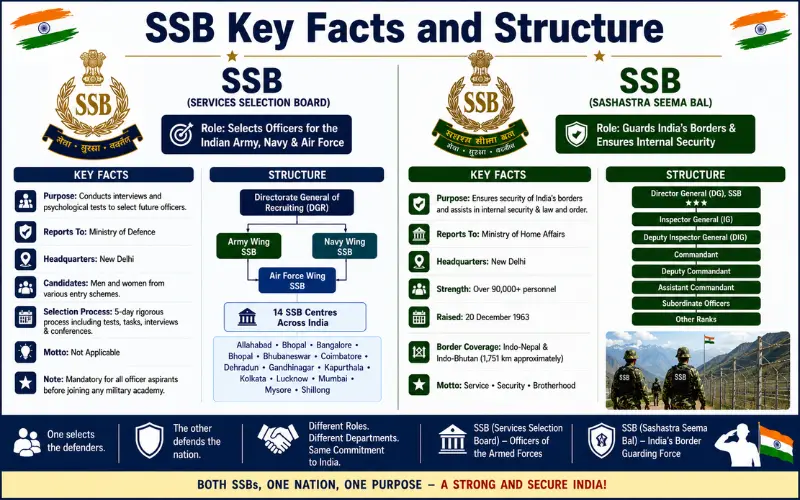
SSB Key Facts and Structure
| Detail | Information |
| Full Form | Services Selection Board |
| Purpose | Officer selection for Indian Army, Navy, Air Force |
| Duration | 5 days (Day 0 to Day 5) |
| Total SSB Centres | 14 across India |
| Army Boards | 4 (Allahabad, Bhopal, Bangalore, Kapurthala) |
| Navy Boards | 5 (Bhopal, Bangalore, Coimbatore, Visakhapatnam, Mumbai) |
| Air Force Boards | 5 (Mysuru, Dehradun, Gandhinagar, Varanasi, Guwahati) |
| Assessment Team | Psychologist, GTO, Interviewing Officer |
| Attempt Limit | No upper limit |
Which Entry Schemes Lead to SSB
Candidates reach SSB through multiple pathways. Each route has a different written exam, but the SSB process is identical across all of them.
- NDA (National Defence Academy): For Class 12 students. UPSC conducts the written exam. Candidates appear for SSB at Army, Navy, or Air Force boards depending on their service preference.
- CDS (Combined Defence Services): For graduates. UPSC conducts the written exam. Candidates appear for IMA, OTA, Naval Academy, or Air Force Academy.
- AFCAT (Air Force Common Admission Test): For Air Force officer entry. IAF conducts its own written exam. SSB is conducted at Air Force Selection Boards (AFSB).
- TES (Technical Entry Scheme): Direct entry for Class 12 PCM students into Army technical arms. No written exam, direct SSB call.
- NCC Special Entry: Candidates with NCC ‘C’ certificate get a direct SSB call without clearing the NDA/CDS written exam.
- University Entry Scheme (UES): Final year engineering students from select universities get direct SSB calls from the Army.
- JAG (Judge Advocate General): For law graduates seeking legal branch commission.
- Short Service Commission (SSC) entries: Multiple branch-specific entries for technical and non-technical graduates.
One thing most articles skip: the number of SSB attempts is truly unlimited. A candidate who fails can reappear. Many successful officers attempted SSB three, four, or five times before getting recommended. The system is designed this way deliberately. The board believes maturity and genuine growth show up in later attempts.
The Three-Way Assessment Model: Why It Is Built This Way
The SSB uses three independent assessors who evaluate you across different domains and compare notes only at the end. This is intentional.
The Psychologist focuses on your personality structure: values, consistency, emotional stability, and the unconscious patterns revealed in written tests.
The GTO focuses on your behaviour in social and task-oriented settings: how you perform under pressure, how you relate to peers, and whether your leadership emerges naturally or is performed.
The Interviewing Officer focuses on your biography, achievements, self-awareness, and how you think on your feet.
If all three independently assess you as officer-like, the recommendation is strong. If two agree and one dissents, a discussion happens at the Conference. If only one assessor rates you highly, you are almost certainly not recommended. The system is built to prevent any single bias, personal chemistry, or one-day performance from deciding your fate.
Why Good Candidates Get Rejected: The Honest List
This is the section nobody writes. These are the real, recurring reasons for rejection:
1. Trained behaviour over genuine personality. Candidates who attend coaching that teaches them to “act” like officers instead of developing genuine OLQs are usually caught. The psychological tests specifically reveal patterns that coached answers cannot fake across 60 responses.
2. Inconsistency across assessors. Being confident in the personal interview but passive in group tasks signals a performance, not a personality. The three-assessor model catches this every time.
3. Herd behaviour in group tasks. Going along with the loudest voice in the group without contributing your own thinking signals low initiative and poor reasoning ability.
4. Negative story themes in TAT. Consistently writing stories where the hero gives up, gets betrayed, or fails without resolution reflects your psychological outlook on adversity. It is more revealing than most candidates realize.
5. Poor stamina management. Candidates who are energetic on Day 3 but visibly checked out by the afternoon of Day 4 are showing the board exactly what the Stamina OLQ is measuring.
6. Self-description gaps. Writing that everyone sees you as confident and decisive, then behaving with visible hesitation during GTO tasks, is a contradiction the psychologist flags immediately.
SSB vs. AFSB: The Differences Most Articles Ignore
When the Indian Air Force conducts SSB for AFCAT and NDA Air Force entries, the board is technically called AFSB (Air Force Selection Board), not SSB. The process is nearly identical but with one notable difference.
The Air Force places additional weight on the Pilot Aptitude Battery Test (PABT) for flying branch candidates. This is a computer-based test measuring multi-tasking ability, spatial reasoning, and instrument reading speed. Only candidates who pass PABT are eligible for the flying branch. Failing PABT does not disqualify you from ground duty branches.
The AFSB also has its own set of five centres (different from Army SSB centres), and the assessors are Air Force officers specifically trained for the Air Force’s officer profile requirements.
Recommended vs. Selected: The Step Most People Don’t Know About
Being recommended by SSB does not mean you are selected for the armed forces. It means you have cleared the officer evaluation. What happens next:
- A medical examination is conducted by Military Doctors at a designated hospital.
- Medically fit candidates are placed on a merit list, ranked by their combined written exam score and SSB marks.
- Only candidates who are high enough on the merit list to fall within available vacancies actually receive training academy admission.
Candidates who are recommended but medically unfit can appeal to a Review Medical Board (RMB). Candidates who are recommended and medically fit but ranked below the vacancy cutoff are placed on a waiting list and may be called if vacancies open.
This is why clearing SSB brilliantly is necessary but not sufficient. The written exam score still matters significantly for final selection.
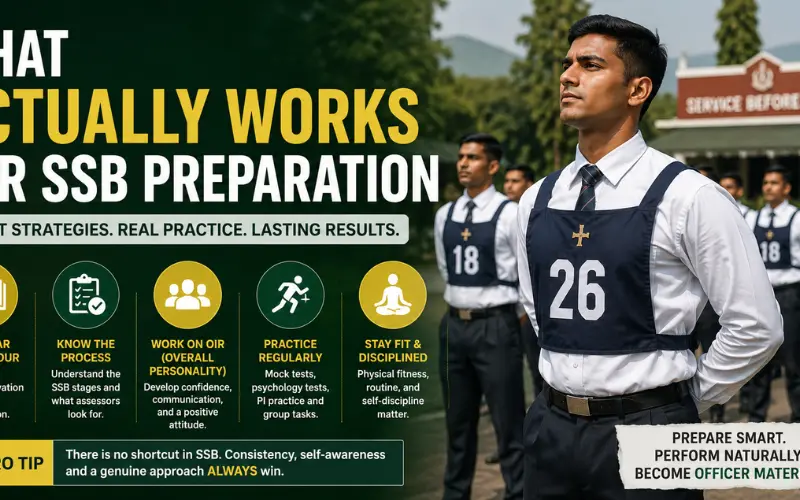
What Actually Works for SSB Preparation
Read the newspaper daily.
Not for facts, but for opinion formation. The GD and Lecturette require you to take structured positions on current events. Candidates who reason through an issue rather than recite headlines stand out immediately.
Practice WAT and SRT consistently.
Write 60 WAT responses under time pressure each week. Review patterns in your own answers. Recurring themes of blame, passivity, or anxiety need to be addressed at the personality level, not just the test level.
Join a sports team or take a community leadership role.
Not for the resume line. Real group experiences give you authentic material for the personal interview and shape the OLQs that SSB actually tests.
Physical fitness is non-negotiable.
Individual Obstacles require functional strength, coordination, and the willingness to attempt high-risk tasks publicly. Candidates who hesitate at an obstacle reveal their response to risk and performance pressure simultaneously.
Work on self-awareness, not self-presentation.
The Self-Description Test specifically probes whether you know yourself accurately. Assessors value honest self-assessment far more than a polished self-image. Officers who cannot see their own weaknesses cannot grow. The board knows this.
FAQ: SSB Full Form and Related Questions
What is the full form of SSB in the context of Indian defence?
SSB stands for Services Selection Board. It is the evaluation body that assesses defence aspirants across five days using psychological tests, group tasks, and a personal interview to determine suitability for officer commission in the Indian Armed Forces.
Is SSB the same as Sashastra Seema Bal?
No, they are completely different organizations sharing the same abbreviation. Sashastra Seema Bal is a border guarding CAPF under the Ministry of Home Affairs. Services Selection Board is the officer selection body for the Army, Navy, and Air Force.
How many times can a candidate attempt SSB?
There is no upper limit. A candidate can appear as many times as they qualify through the respective written exams. Many serving officers cleared SSB on their third, fourth, or fifth attempt.
What is the overall recommendation rate at SSB?
Broadly, about 30-40% of candidates clear the Day 1 screening. Of those who continue, roughly 10-15% receive a final recommendation. The overall recommendation rate from all appearing candidates typically falls between 5-10%, making it one of the most selective evaluations in India.
Can you prepare for SSB in one month?
One month is enough to understand the format, practice WAT and SRT, and improve current affairs knowledge. Building genuine Officer-Like Qualities takes sustained effort over months. The SSB assesses your actual personality, and test familiarity alone will not get you recommended.
What is the difference between GTO and IO in SSB?
The GTO (Group Testing Officer) observes your behaviour in group and physical task settings over two full days. The IO (Interviewing Officer) conducts the one-on-one personal interview. Both independently assess the same 15 OLQs, making it very difficult to fake consistency across both.
Does my SSB score affect final selection or just the recommendation?
Both. Being recommended is the first gate. After that, your SSB marks combine with your written exam marks to form a merit list. Final admission depends on where you rank on this combined list relative to the number of available vacancies.
What should I do after getting a “Not Recommended” result from SSB?
Listen carefully to the brief feedback given at the Conference. Identify which specific OLQs you lacked: passivity in groups, inconsistent story themes, or poor decision speed. Work on those areas genuinely, not just in practice tests. Then reappear when you are authentically more prepared, not just more familiar with the format.
Final Thoughts
Understanding the SSB Full Form is only the beginning. The Services Selection Board (SSB) is not a test of memorized knowledge it is a comprehensive assessment of your personality, leadership potential, decision-making ability, and Officer-Like Qualities (OLQs). Over its rigorous five-day selection process, the SSB evaluates whether a candidate has the character, confidence, and integrity required to lead men and women in the Indian Armed Forces.
Whether you’re preparing for NDA, CDS, AFCAT, TES, or other officer entry schemes, understanding how the SSB works gives you a significant advantage. Focus on developing genuine leadership, communication, teamwork, and self-awareness rather than trying to memorize “perfect” answers.
These qualities not only improve your chances of recommendation but also help you grow into a capable future officer. We hope this guide has answered all your questions about the SSB Full Form and provided a clear roadmap for one of India’s most respected and challenging officer selection processes.