

On-the-Job Training (OJT) is a practical learning method in which employees, students, or trainees develop job-related skills while performing actual work under the guidance of an experienced supervisor or mentor. Instead of learning only in a classroom, trainees gain real-world experience by completing everyday tasks in a professional work environment.
This approach helps learners understand workplace expectations, improve technical skills, and build confidence before taking on responsibilities independently.
Quick Answer:
OJT Full Form = On-the-Job Training. It is a hands-on training method where people learn by performing real work under supervision.
What Is On-the-Job Training (OJT)?
On-the-Job Training is a structured process that allows people to learn while working. New employees, interns, apprentices, and students receive guidance from experienced professionals who teach them how to perform job-specific tasks correctly and efficiently.
Unlike traditional classroom learning, OJT combines theory with practical experience. Learners observe experienced workers, practice tasks themselves, receive immediate feedback, and gradually become independent in their roles.
Many organizations use OJT because it shortens the learning curve and helps employees become productive faster.
Why Is OJT Important?
Learning from books or online courses is valuable, but practical experience is equally important. OJT bridges the gap between theoretical knowledge and workplace performance.
Here are some reasons why OJT is widely used:
- Helps learners understand real workplace situations.
- Builds confidence through practical experience.
- Improves technical and interpersonal skills.
- Reduces mistakes by providing expert guidance.
- Makes employees productive in less time.
- Helps organizations develop skilled and job-ready professionals.
For students, OJT provides valuable industry exposure before graduation. For employers, it creates a workforce that understands company procedures and quality standards.
Key Features of On-the-Job Training
The following characteristics make OJT one of the most effective training methods:
| Feature | Description |
|---|---|
| Hands-on Learning | Learn by performing real job tasks. |
| Workplace-Based | Training takes place in the actual work environment. |
| Supervised Learning | Experienced employees guide trainees throughout the process. |
| Immediate Feedback | Mistakes are corrected quickly to improve performance. |
| Practical Experience | Learners gain industry-specific knowledge and confidence. |
| Skill Development | Improves both technical and soft skills. |
Objectives of OJT
Organizations invest in On-the-Job Training to prepare employees for long-term success. The primary objectives include:
Develop Practical Skills
Employees learn how to use tools, equipment, software, and workplace procedures that are directly related to their job.
Improve Productivity
Proper training helps employees perform tasks efficiently, reducing the time required to reach full productivity.
Build Workplace Confidence
Regular guidance and practice help new employees become comfortable with their responsibilities.
Reduce Errors
Employees who receive structured training make fewer mistakes because they understand the correct procedures from the beginning.
Strengthen Teamwork
Working alongside experienced colleagues helps trainees improve communication, collaboration, and professional behavior.
Prepare Future Leaders
Many organizations use OJT to identify talented employees and prepare them for higher responsibilities.
How Does On-the-Job Training Work?
Although every organization has its own training process, most OJT programs follow similar steps.
Step 1: Orientation
The trainee is introduced to the company, workplace rules, safety procedures, and job responsibilities.
Step 2: Observation
The trainee watches experienced employees perform daily tasks and learns standard procedures.
Step 3: Guided Practice
The trainee begins performing assigned tasks under close supervision while receiving continuous support.
Step 4: Feedback
Supervisors evaluate performance, identify improvement areas, and provide constructive suggestions.
Step 5: Independent Work
After demonstrating competence, the trainee performs job duties with minimal supervision.
Types of On-the-Job Training
Organizations choose different OJT methods depending on the job role, industry, and learning objectives.
Job Shadowing
In job shadowing, trainees observe experienced professionals during their daily work. This method helps beginners understand workflows, workplace culture, and responsibilities before performing tasks themselves.
Example: A new nurse observes a senior nurse during patient care.
Coaching
Coaching involves one-on-one guidance from a supervisor or experienced employee. Coaches provide practical advice, monitor progress, and help trainees improve their performance.
Best for: Sales, customer service, leadership, and technical roles.
Mentoring
Mentoring focuses on long-term professional growth. Mentors share knowledge, career advice, and workplace experience beyond daily job responsibilities.
Example: A senior software engineer mentoring a junior developer.
Job Rotation
Employees work in different departments or roles for a specific period. This broadens their understanding of business operations and develops multiple skills.
Example: A management trainee spends time in HR, finance, marketing, and operations.
Apprenticeship
Apprenticeships combine classroom education with practical workplace training over several months or years. They are common in skilled trades and technical professions.
Examples include:
- Electricians
- Carpenters
- Mechanics
- Welders
- Plumbers
Internship-Based OJT
Many colleges require students to complete workplace training before graduation. This allows them to apply classroom knowledge in real business environments.
Common fields include:
- Healthcare
- Engineering
- Information Technology
- Hospitality
- Business Administration
- Education
Benefits of OJT at a Glance
| For Employees | For Employers |
|---|---|
| Gain practical experience | Build a skilled workforce |
| Improve confidence | Increase productivity |
| Learn faster | Reduce recruitment costs |
| Develop communication skills | Lower training expenses |
| Increase career opportunities | Improve employee retention |
| Understand workplace culture | Maintain quality standards |
Common Industries That Use OJT
Almost every industry uses On-the-Job Training to prepare employees.
Some of the most common sectors include:
- Healthcare
- Information Technology
- Manufacturing
- Construction
- Banking and Finance
- Retail
- Hospitality
- Education
- Government Organizations
- Logistics
- Engineering
- Aviation
Each industry customizes its OJT program to meet specific job requirements while ensuring employees gain practical experience safely and efficiently.
Benefits of On-the-Job Training (OJT)
On-the-Job Training benefits both employees and employers. Employees gain practical skills and confidence, while organizations build a productive workforce that understands company processes and standards.
Let’s explore these benefits in detail.
Benefits of OJT for Employees
Learn Through Real Experience
One of the biggest advantages of OJT is learning by doing. Instead of only reading manuals or attending classroom sessions, trainees perform real tasks in an actual work environment.
This hands-on approach helps learners understand their responsibilities much faster.
Develop Job-Ready Skills
Every workplace has unique tools, software, equipment, and procedures. OJT helps employees master these job-specific skills through daily practice.
This makes them better prepared for long-term career success.
Build Confidence
Many people feel nervous when starting a new job. Working alongside experienced professionals helps reduce anxiety and increases confidence.
Employees gradually become comfortable making decisions and handling responsibilities independently.
Receive Immediate Feedback
Mistakes are a natural part of learning. During OJT, supervisors identify errors quickly and explain the correct approach.
Immediate feedback helps employees improve faster and avoid repeating mistakes.
Improve Communication Skills
Working with managers, colleagues, and customers teaches valuable workplace communication.
Employees learn how to:
- Communicate professionally
- Work as part of a team
- Solve workplace problems
- Handle customer interactions
- Manage responsibilities effectively
Increase Career Opportunities
Practical experience is highly valued by employers.
Employees who complete structured OJT often have better chances of:
- Receiving promotions
- Getting permanent employment
- Earning higher salaries
- Taking on leadership roles
Benefits of OJT for Employers
Organizations also gain significant advantages from investing in structured training programs.
Faster Employee Productivity
Employees begin contributing sooner because they learn while working instead of spending weeks in classroom training.
Lower Training Costs
Companies save money by using experienced employees as trainers and teaching skills directly in the workplace.
Better Work Quality
Employees trained according to company standards are more likely to produce consistent, high-quality work.
Higher Employee Retention
Workers who receive proper guidance during their first few weeks are generally more satisfied and less likely to leave the organization.
Stronger Workplace Culture
Training helps new employees understand company values, policies, and expectations from day one.
Real-Life Examples of OJT
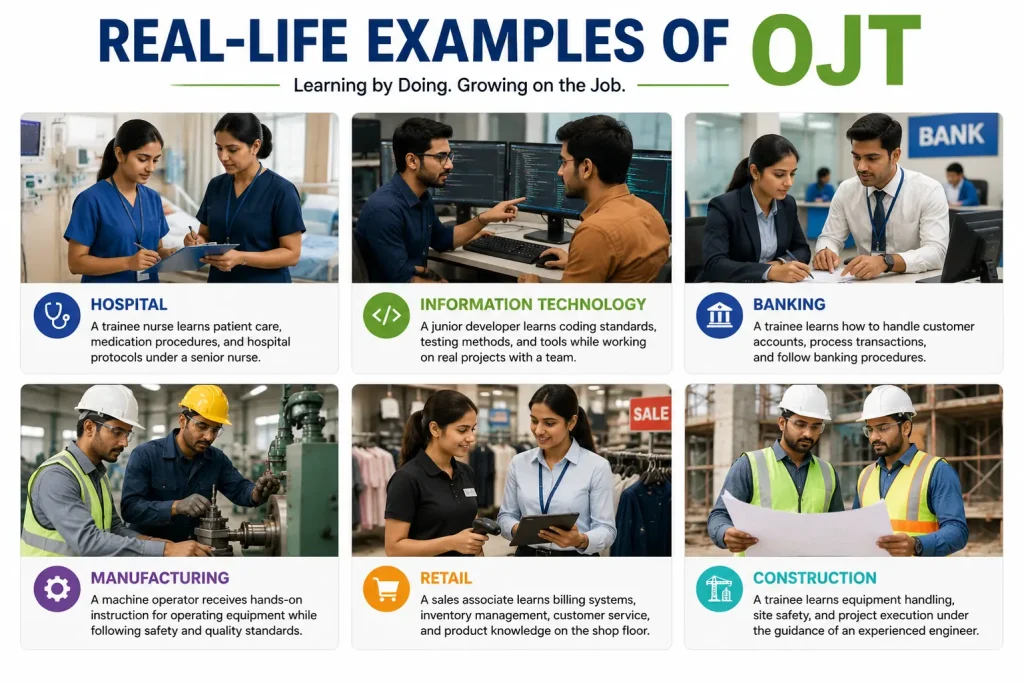
Understanding OJT becomes easier when you see how it works in different professions.
Example 1: Hospital
A newly hired nurse works under the supervision of a senior nurse to learn patient care, medication procedures, and hospital protocols.
Example 2: Information Technology
A junior software developer joins a project team and learns coding standards, testing methods, and development tools while working on real applications.
Example 3: Banking
A bank trainee learns how to handle customer accounts, process transactions, and follow security procedures under the guidance of an experienced officer.
Example 4: Manufacturing
A machine operator receives hands-on instruction for operating equipment safely while following quality standards.
Example 5: Retail
A sales associate learns billing systems, inventory management, customer service, and product knowledge directly on the shop floor.
OJT in Different Industries
Although the training method is similar, every industry focuses on different skills.
| Industry | Typical OJT Activities |
|---|---|
| Healthcare | Patient care, medical equipment, documentation |
| Information Technology | Programming, testing, cloud platforms, cybersecurity |
| Manufacturing | Machine operation, quality inspection, safety procedures |
| Hospitality | Guest service, reservations, food preparation |
| Retail | Sales, inventory management, customer support |
| Banking | Financial transactions, compliance, customer handling |
| Construction | Equipment handling, workplace safety, project execution |
| Education | Classroom management, lesson planning, student engagement |
OJT vs Internship
Many people confuse On-the-Job Training with internships. While both involve workplace learning, they serve different purposes.
| Feature | OJT | Internship |
|---|---|---|
| Purpose | Learn job responsibilities | Gain industry exposure |
| Participants | Employees, students, trainees | Mostly students |
| Duration | Days to several months | Weeks to several months |
| Payment | Often paid | Paid or unpaid |
| Focus | Job-specific skills | Career exploration and practical learning |
| Outcome | Improved workplace performance | Academic or professional experience |
Key Difference:
An internship mainly provides exposure to an industry, while OJT prepares someone to perform a specific job effectively.
OJT vs Apprenticeship
Although both involve practical training, apprenticeships are usually longer and more structured.
| Feature | OJT | Apprenticeship |
|---|---|---|
| Duration | Short to medium term | Long term, often 1 to 4 years |
| Structure | Flexible | Highly structured |
| Education | Mostly workplace learning | Workplace learning plus formal education |
| Common Fields | Offices, hospitals, retail, IT | Skilled trades and technical professions |
| Certification | Sometimes provided | Usually includes recognized certification |
OJT vs Off-the-Job Training
Both methods are useful, but they differ significantly.
| Feature | On-the-Job Training | Off-the-Job Training |
|---|---|---|
| Learning Location | Workplace | Classroom or training center |
| Practical Experience | High | Limited |
| Cost | Lower | Higher |
| Productivity | Employees contribute while learning | Productivity pauses during training |
| Feedback | Immediate | Usually delayed |
| Learning Style | Practical | Theoretical |
Common Challenges of OJT
Although OJT offers many advantages, it also has a few challenges.
Some common issues include:
- Inconsistent training methods
- Limited supervision
- Poor documentation
- Trainers with little teaching experience
- Lack of structured learning plans
- Time pressure in busy workplaces
Fortunately, these challenges can be reduced through proper planning and regular performance evaluations.
Best Practices for Effective OJT
Organizations can make their training programs more successful by following these best practices.
Set Clear Learning Goals
Define exactly what the trainee should know by the end of the program.
Assign Experienced Mentors
Choose knowledgeable employees who can guide trainees patiently and professionally.
Provide Regular Feedback
Frequent discussions help trainees understand their strengths and areas for improvement.
Encourage Questions
Creating an open learning environment allows trainees to gain confidence and solve problems more effectively.
Monitor Progress
Use checklists, practical assessments, and performance reviews to measure improvement throughout the training period.
Focus on Safety
In industries such as healthcare, manufacturing, and construction, safety procedures should always be part of the training process.
Common Mistakes to Avoid During OJT
A successful OJT program avoids these common errors:
- Giving responsibilities too quickly without guidance
- Ignoring employee questions
- Providing unclear instructions
- Skipping performance reviews
- Failing to document progress
- Assuming every trainee learns at the same pace
Avoiding these mistakes creates a better learning experience and improves overall productivity.
OJT Duration
The duration of On-the-Job Training depends on the industry, job role, and organization. Some positions require only a few days of training, while others need several months to ensure employees are fully prepared.
Here is a general guideline:
| Job Type | Typical OJT Duration |
|---|---|
| Retail and Customer Service | 1 to 4 weeks |
| Office Administration | 2 to 6 weeks |
| Banking | 1 to 3 months |
| Information Technology | 1 to 6 months |
| Healthcare | 3 to 12 months |
| Manufacturing | 2 weeks to 6 months |
| Apprenticeships | 1 to 4 years |
The goal is not to complete training quickly, but to ensure trainees can perform their responsibilities confidently and independently.
Who Can Apply for OJT?
On-the-Job Training is suitable for many types of learners and professionals.
Eligible participants often include:
- College and university students
- Fresh graduates
- Newly hired employees
- Career changers
- Technical and vocational students
- Apprentices
- Government training program participants
Some organizations may require specific educational qualifications, certifications, or background checks depending on the role.
How Is OJT Assessed?
Most organizations evaluate trainees throughout the program instead of relying on a single final test.
Common assessment methods include:
Practical Performance
Supervisors observe how well trainees perform daily tasks.
Attendance
Regular attendance demonstrates commitment and professionalism.
Skill Evaluation
Managers assess technical abilities, communication skills, and teamwork.
Progress Reports
Many organizations require weekly or monthly progress reports to track improvement.
Final Evaluation
At the end of the program, supervisors determine whether the trainee has achieved the required level of competency.
What Is an OJT Certificate?
After successfully completing the training, many organizations issue an OJT Certificate.
This certificate confirms that the trainee has completed practical workplace training and demonstrated the required skills.
An OJT certificate may include:
- Trainee’s name
- Organization name
- Training duration
- Department
- Skills learned
- Supervisor’s signature
- Completion date
Adding an OJT certificate to your resume can strengthen your job application by showing employers that you have practical workplace experience.
Career Opportunities After OJT
Completing OJT often opens the door to better career opportunities.
Many employers prefer candidates who already understand workplace procedures and have practical experience.
Depending on your field, OJT can help you become:
- Staff Nurse
- Software Developer
- Accountant
- Marketing Executive
- Sales Representative
- Mechanical Engineer
- Civil Engineer
- Teacher
- Hotel Manager
- Bank Officer
- Customer Service Executive
- Human Resources Professional
Some companies even offer full-time employment to trainees who perform well during their OJT program.
Common Myths About OJT
Many people misunderstand On-the-Job Training. Let’s separate myths from facts.
| Myth | Reality |
|---|---|
| OJT is only for students. | Professionals, new employees, and career changers also receive OJT. |
| OJT is the same as an internship. | Internships focus on industry exposure, while OJT develops job-specific skills. |
| OJT is only for technical jobs. | Almost every industry uses OJT, including healthcare, banking, education, retail, and IT. |
| OJT takes years to complete. | Many programs last only a few weeks or months. |
| OJT has no value on a resume. | Practical workplace experience is highly valued by employers. |
Expert Tips to Make the Most of OJT
Whether you’re a student or a new employee, these tips can help you succeed.
- Arrive on time every day.
- Ask thoughtful questions when you’re unsure.
- Take notes during training sessions.
- Accept feedback with a positive attitude.
- Practice tasks regularly.
- Observe experienced professionals carefully.
- Follow workplace safety rules.
- Build professional relationships with your colleagues.
- Stay curious and eager to learn.
- Keep track of the skills you develop.
These habits will help you gain more from your training and leave a positive impression on your supervisors.
Frequently Asked Questions (FAQs)
What is the full form of OJT?
OJT stands for On-the-Job Training. It is a practical training method where people learn by performing real work under the guidance of experienced professionals.
What is the purpose of OJT?
The main purpose of OJT is to help employees or students gain practical skills, improve job performance, and become productive more quickly.
Who needs On-the-Job Training?
OJT is useful for students, fresh graduates, new employees, apprentices, and professionals transitioning to new roles.
Is OJT paid?
It depends on the organization. Many companies provide paid OJT for employees, while some student internships or training programs may be unpaid.
Is OJT compulsory?
Many colleges, universities, and vocational institutions require OJT as part of their academic curriculum. Employers may also require OJT for new hires.
What skills can you learn during OJT?
You can develop technical skills, communication, teamwork, leadership, problem-solving, customer service, and time management skills.
What is the difference between OJT and classroom training?
Classroom training focuses on theory, while OJT allows learners to apply knowledge in real workplace situations.
Can OJT help you get a job?
Yes. Practical experience gained during OJT makes candidates more attractive to employers and can improve employment opportunities.
Is OJT only for large companies?
No. Small businesses, startups, educational institutions, hospitals, government agencies, and multinational companies all use OJT.
Why do employers prefer candidates with OJT experience?
Candidates with OJT experience often require less supervision, adapt more quickly to workplace environments, and contribute sooner to organizational goals.
Is OJT useful for career growth?
Yes. OJT improves practical skills, builds confidence, and enhances employability, making it easier to secure promotions or new job opportunities.
Final Thoughts
Understanding the OJT Full Form, which stands for On-the-Job Training, is the first step toward appreciating how valuable practical learning is in today’s workplace. Unlike classroom-based instruction, OJT allows individuals to learn while performing real tasks, receive immediate feedback, and build confidence through hands-on experience.
Whether you are a student preparing for your first job, a recent graduate entering the workforce, or an employer developing new talent, OJT creates a strong foundation for long-term success. It not only improves technical knowledge but also strengthens communication, teamwork, and problem-solving skills that are essential in almost every profession.
As industries continue to evolve, organizations increasingly value professionals who can apply knowledge in real-world situations. A well-structured On-the-Job Training program benefits everyone involved by creating skilled employees, improving productivity, and supporting continuous career growth.