
If you’ve seen MFG on product labels, invoices, business documents, or manufacturing reports, you may wonder what it means.
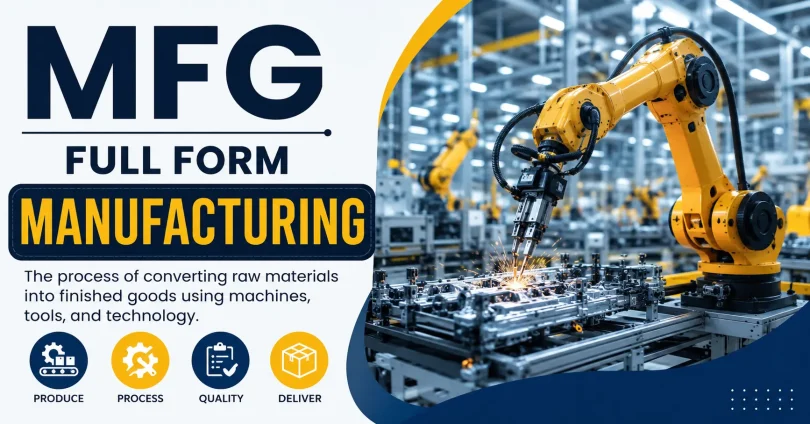
MFG Full Form is Manufacturing.
Manufacturing is the process of converting raw materials or individual components into finished products using labor, machinery, tools, and technology. From smartphones and cars to medicines and packaged foods, nearly every product we use every day goes through a manufacturing process.
In this guide, you’ll learn what MFG means, how manufacturing works, its different types, real-world examples, advantages, disadvantages, and why manufacturing is one of the most important industries in the global economy.
MFG Full Form
| Abbreviation | Full Form |
|---|---|
| MFG | Manufacturing |
Manufacturing refers to producing finished goods from raw materials through a series of planned processes. These products are then sold to consumers or supplied to businesses for further use.
What Does MFG Mean?
MFG is a widely used abbreviation for Manufacturing in business, engineering, logistics, production, and supply chain management.
You may also see MFG in different contexts, such as:
- Product packaging
- Factory labels
- Inventory systems
- Business reports
- Purchase orders
- Shipping documents
For example:
- MFG Date: Manufacturing Date
- MFG Unit: Manufacturing Unit
- MFG Cost: Manufacturing Cost
- MFG Process: Manufacturing Process
Simple Definition of Manufacturing
Manufacturing is the process of transforming raw materials into finished products through physical, chemical, or mechanical methods.
It combines:
- Raw materials
- Human skills
- Machinery
- Technology
- Quality control
- Packaging
- Distribution
The goal is to create products that meet customer needs while maintaining quality and efficiency.
Why Is Manufacturing Important?
Manufacturing is the backbone of economic development. It creates products that people use every day while generating employment, supporting businesses, and driving innovation.
Key Benefits of Manufacturing
- Creates millions of jobs
- Boosts economic growth
- Encourages technological innovation
- Supports exports and international trade
- Improves infrastructure development
- Strengthens supply chains
- Increases productivity
- Promotes industrial development
Without manufacturing, industries such as healthcare, construction, transportation, electronics, and agriculture would struggle to operate efficiently.
How Does the Manufacturing Process Work?
Although the exact process varies by industry, most manufacturers follow these common steps.
Product Planning
Every product starts with an idea. Designers and engineers determine the product’s purpose, materials, and specifications.
Market Research
Businesses study customer demand, competitors, pricing, and market trends before starting production.
Material Procurement
Raw materials are purchased from reliable suppliers.
Examples include:
- Steel
- Plastic
- Wood
- Cotton
- Chemicals
- Electronic components
Production
Machines and workers transform raw materials into finished products through cutting, molding, welding, assembling, or processing.
Quality Inspection
Every product is checked for defects to ensure it meets safety and quality standards.
Packaging
Products are packed securely with labels, instructions, and barcodes.
Distribution
Finished goods are transported to warehouses, retailers, or customers.
Types of Manufacturing
Different industries use different manufacturing methods depending on the product and production volume.
Mass Manufacturing
Produces identical products in large quantities.
Examples:
- Cars
- Bottled water
- Mobile phones
Batch Manufacturing
Products are made in specific batches before switching to another batch.
Examples:
- Medicines
- Bakery products
- Cosmetics
Job Shop Manufacturing
Custom-made products are produced based on customer requirements.
Examples:
- Custom furniture
- Machine parts
- Jewelry
Continuous Manufacturing
Production runs continuously with little or no interruption.
Examples:
- Oil refining
- Cement production
- Chemical plants
Lean Manufacturing
Focuses on reducing waste while improving productivity and quality.
Popular principles include:
- Just-in-Time inventory
- Continuous improvement
- Waste reduction
Flexible Manufacturing
Uses automation and robotics to manufacture different products with minimal downtime.
Additive Manufacturing
Also known as 3D Printing, this method builds products layer by layer using digital designs.
It is widely used in:
- Aerospace
- Medical devices
- Automotive prototyping
Real-Life Examples of Manufacturing
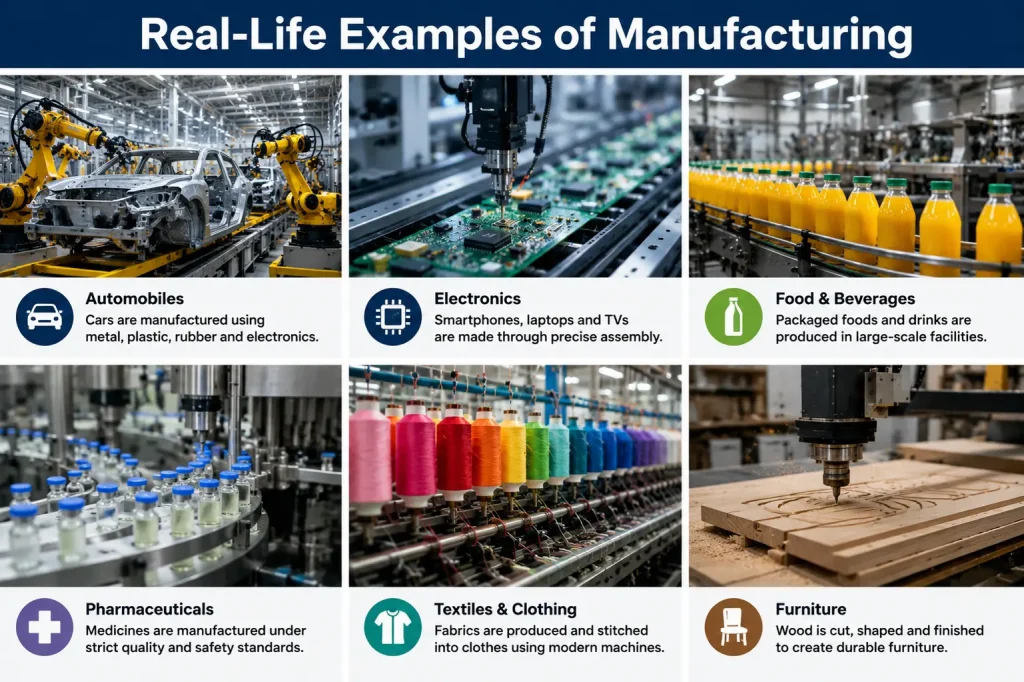
Manufacturing exists in almost every industry.
| Industry | Example |
|---|---|
| Automotive | Toyota manufactures cars and engines |
| Electronics | Samsung produces smartphones and televisions |
| Food | Nestlé manufactures packaged foods |
| Pharmaceuticals | Pfizer manufactures medicines and vaccines |
| Furniture | IKEA manufactures home furniture |
| Clothing | Nike manufactures sportswear and shoes |
These companies convert raw materials into products used by millions of people worldwide.
Manufacturing vs Production
Many people think manufacturing and production are the same, but they are different.
| Manufacturing | Production |
|---|---|
| Produces physical goods | Produces goods or services |
| Requires raw materials | May not require raw materials |
| Uses machinery and factories | Can include service industries |
| Creates tangible products | Creates tangible or intangible outputs |
| Example: Car manufacturing | Example: Software development |
In simple terms, manufacturing is a part of production, but production includes much more than manufacturing.
Advantages of Manufacturing
Manufacturing offers several benefits to businesses and economies.
Business Advantages
- Higher production efficiency
- Lower production costs
- Better product consistency
- Improved quality control
- Increased profits
- Faster production
Economic Advantages
- Creates employment opportunities
- Supports local industries
- Encourages exports
- Promotes innovation
- Improves living standards
Challenges of Manufacturing
Despite its benefits, manufacturing also has some challenges.
- High setup costs
- Dependence on raw materials
- Supply chain disruptions
- Rising energy costs
- Environmental concerns
- Skilled labor shortages
- Strict government regulations
Modern manufacturers address these challenges by adopting automation, renewable energy, and sustainable production methods.
Modern Manufacturing Trends You Should Know
Many competitor articles stop at traditional manufacturing. Today’s industry is changing rapidly through advanced technologies.
Smart Manufacturing
Factories use connected machines, sensors, and real-time data to improve productivity.
Artificial Intelligence
AI helps manufacturers predict machine failures, improve quality control, reduce waste, and optimize production schedules.
Industrial Robots
Robots perform repetitive tasks with high precision, improving efficiency and workplace safety.
Internet of Things (IoT)
Connected devices monitor equipment performance and send real-time alerts when maintenance is needed.
Sustainable Manufacturing
Companies are reducing waste, saving energy, recycling materials, and lowering carbon emissions to create environmentally friendly products.
These innovations are often referred to as Industry 4.0, the next generation of manufacturing powered by digital technology and automation.
Common Terms Related to MFG
Understanding these related terms can help you better interpret manufacturing documents.
| Term | Meaning |
|---|---|
| MFG Date | Manufacturing Date |
| MFG Cost | Cost of producing a product |
| OEM | Original Equipment Manufacturer |
| SKU | Stock Keeping Unit |
| Supply Chain | Network involved in producing and delivering products |
| Quality Control | Process of ensuring products meet standards |
Frequently Asked Questions
What is the full form of MFG?
MFG stands for Manufacturing.
What is manufacturing?
Manufacturing is the process of converting raw materials into finished products using labor, machinery, and technology.
What is the difference between manufacturing and production?
Manufacturing focuses only on producing physical goods, while production includes both goods and services.
Where is MFG commonly used?
MFG is commonly used in factories, invoices, product labels, inventory systems, shipping documents, and business reports.
What does MFG Date mean?
MFG Date refers to the Manufacturing Date, which indicates when a product was produced.
Which industries use manufacturing?
Manufacturing is used in automotive, electronics, pharmaceuticals, food processing, textiles, aerospace, construction, healthcare, and many other industries.
Conclusion
Understanding the MFG full form is useful whether you’re a student, job seeker, business owner, or simply reading product labels. Manufacturing is much more than making products. It is a structured process that combines people, technology, machinery, and innovation to produce the goods we depend on every day.
As industries continue adopting smart factories, artificial intelligence, and sustainable production methods, manufacturing will remain one of the most important drivers of global economic growth and technological progress.