
Have you ever wondered what the term axis full form Whether you’re learning about geometry, physics, or just curious about how things rotate, the word “axis” pops up quite often.
But what exactly does the “axis full form” stand for? Simply put, it’s all about the invisible line that helps things spin or stay in balance.
From the Earth’s rotation to a spinning top, the axis plays a huge role in many things around us.
In this post, we’ll explore what the axis full form is and why it’s such an important concept in science and mathematics. Let’s get started!
What Does “Axis” Stand For?
The term ‘axis’ refers to a straight line around which an object or a geometric figure rotates or is symmetrically arranged.
In simpler terms, it’s the central line that an object spins or moves around, much like how the Earth rotates around its axis.
In the world of geometry, physics, and even engineering, the concept of an axis is crucial for understanding movement, balance, and rotation.
When we say something “rotates around an axis,” we’re talking about how that object moves in a circular or curved path around that fixed line. This axis itself stays in one place while everything else moves around it.
Let’s break it down
- In Geometry: When you rotate any shape (like a circle or a square), it does so around an axis. This line could be through the center of the shape or along its edges. The axis helps define the symmetry and shape of the object, especially when it’s being rotated in space.
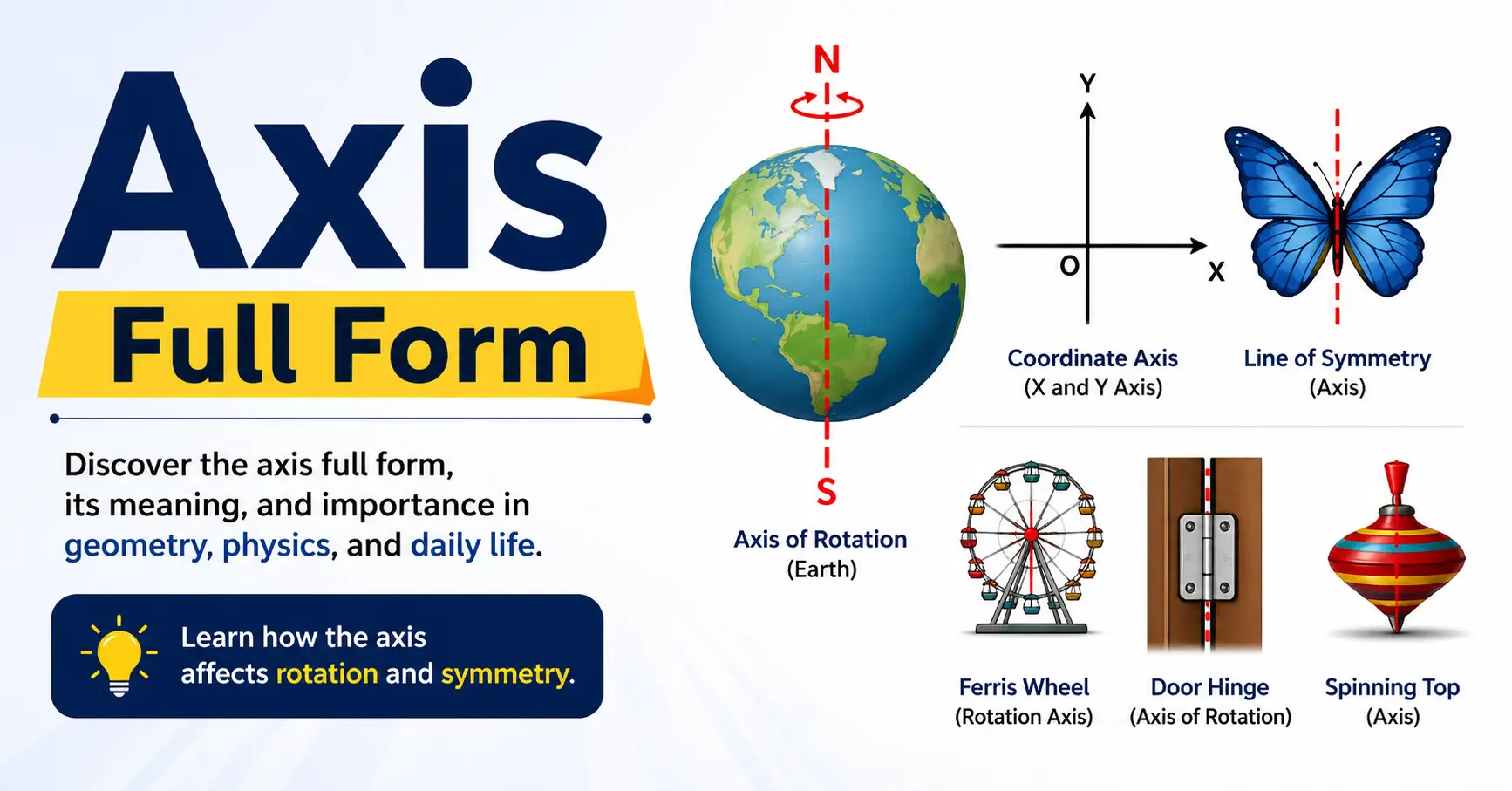
- In Physics: The concept of an axis becomes even more interesting. Take the Earth, for example. The Earth rotates around an imaginary axis that runs from the North Pole to the South Pole. This is the reason we have day and night — the Earth spins on its axis, making different parts of the planet face the sun at different times.
- In Machines and Tools: An axis is also used in engineering, particularly with machinery. In this context, the axis is a fixed line that allows wheels, gears, and other mechanical parts to rotate efficiently. It keeps everything aligned and helps the machine function properly.
Overall, an axis serves as a reference point or a center for rotation, making it an essential concept in both everyday life and advanced scientific studies.
Axis Full Form in English
The full form of the word “axis” is defined as:
“A straight line about which a body or a geometric figure rotates.”
This definition is used in various fields, such as geometry, physics, engineering, and even in astronomy. Let’s break down the meaning in a bit more detail.
Straight Line
The key characteristic of an axis is that it is a straight line. Unlike curves or irregular shapes, an axis is a perfectly straight line, either real or imaginary, that serves as the central point of rotation or symmetry.
About Which a Body Rotates
When we say a “body rotates about an axis,” we mean that the body moves in a circular or elliptical motion around the axis.
The axis itself remains fixed while the object rotates around it.
This motion could be on a large scale, like the Earth rotating around its axis, or on a small scale, such as the wheels of a car spinning around their central axis.
For example
- Earth’s Axis: The Earth spins around an imaginary axis that runs from the North Pole to the South Pole. This rotation gives us day and night.
- Spinning Top: A toy top rotates around its central axis as it spins on the ground. The axis here is the line running through the center of the top.
Geometric Figure
In geometry, the concept of an axis is often used to describe the way shapes and objects rotate or are arranged.
A geometric figure can be symmetrical around an axis, which means if you were to fold the shape along that line, both halves would match perfectly.
For instance
Symmetry in Shapes: Many shapes, like a circle or a square, have an axis of symmetry. The axis divides the shape into two identical parts. For a circle, this axis passes through its center, and for a square, it could pass through its center or along its edges.
Real-World Examples of an Axis
- Wheel Rotation: When a wheel turns, it rotates around its central axis. This is the fixed line that keeps the wheel aligned and balanced as it spins.
- Axle in Vehicles: In vehicles, the axle is the axis around which the wheels rotate, allowing the car to move forward or backward.
To summarize, the “axis full form” in English is simply “A straight line about which a body or a geometric figure rotates”.
This basic idea is foundational in many scientific and practical fields, as it helps explain rotational movement, symmetry, and balance.
Axis Full Form in Hindi
“Axis” का पूर्ण रूप है
“एक सीधी रेखा जिसके चारों ओर कोई वस्तु या ज्यामितीय रूप घुमता है।”
यह परिभाषा विभिन्न क्षेत्रों जैसे गणित, भौतिकी, और यांत्रिकी में प्रयुक्त होती है। आइए इसे और विस्तार से समझते हैं।
सीधी रेखा (Straight Line)
“Axis” का सबसे महत्वपूर्ण गुण यह है कि यह सीधी रेखा होती है। यह रेखा किसी भी वस्तु या आकार के चारों ओर घूमने के लिए केंद्र बिंदु का काम करती है। यह रेखा किसी भी वस्तु के घूमने का आधार बनती है।
जिसके चारों ओर कोई वस्तु या ज्यामितीय रूप घुमता है (Around which a body or figure rotates)
जब हम कहते हैं कि कोई वस्तु “एक एक्सिस के चारों ओर घुमती है,” तो इसका मतलब यह है कि वह वस्तु उस रेखा के चारों ओर घूर्णन करती है। यह रेखा स्थिर रहती है जबकि वस्तु उसकी चारों ओर घूमती रहती है।
उदाहरण के तौर पर
- पृथ्वी का अक्ष: पृथ्वी अपनी धुरी (Axis) के चारों ओर घुमती है, जिससे दिन और रात का निर्माण होता है। पृथ्वी की धुरी उत्तरी ध्रुव से दक्षिणी ध्रुव तक एक काल्पनिक रेखा होती है।
- टॉप का घूमा: जब एक बच्चा टॉप घुमाता है, तो वह अपने केंद्रीय अक्ष (Axis) के चारों ओर घूमता है।
ज्यामितीय रूप (Geometric Figures)
ज्यामिति में, Axis का उपयोग उस रेखा को परिभाषित करने के लिए किया जाता है जिसके चारों ओर कोई ज्यामितीय आकार घूमता है या जिसे केंद्र मानकर किसी आकार की सममितता निर्धारित होती है।
उदाहरण
सममिति (Symmetry) का अक्ष: एक वृत्त (Circle) या वर्ग (Square) का एक या अधिक अक्ष होते हैं, जो उस आकार को दो समान भागों में विभाजित करते हैं। जैसे, एक वर्ग का केंद्र एक अक्ष होता है जिसके चारों ओर वह समान रूप से व्यवस्थित होता है।
वास्तविक उदाहरण (Real-World Examples)
- पहिया (Wheel) का घुमाव: जब एक पहिया घुमता है, तो वह अपने केंद्रीय अक्ष के चारों ओर घूर्णन करता है। यह अक्ष पहिए की घूर्णन क्रिया को नियंत्रित करता है।
- गाड़ी के पहिए का धुरी (Axle): वाहन के पहियों की धुरी वह रेखा होती है जिसके चारों ओर पहिये घूमते हैं और वाहन आगे या पीछे चलता है।
निष्कर्ष
इस प्रकार, “Axis” का पूर्ण रूप हिंदी में “एक सीधी रेखा जिसके चारों ओर कोई वस्तु या ज्यामितीय रूप घुमता है” है। यह अवधारणा गणित, भौतिकी, और इंजीनियरिंग के क्षेत्र में अत्यंत महत्वपूर्ण है, क्योंकि यह घूर्णन और सममिति को समझने में मदद करती है।
आशा है कि यह विवरण आपके लिए स्पष्ट और उपयोगी होगा! यदि आप और कुछ जानना चाहते हैं, तो कृपया बताएं!
FAQs
What is an axis in geometry?
In geometry, an axis is a straight line around which a shape or object can rotate or be reflected. It acts as a central reference point for rotational symmetry. For example, a circle has an axis that passes through its center, and if you rotate the circle around this axis, it will look the same from every angle. The axis helps define the balance and symmetry of geometric figures.
What is the importance of the Earth’s axis?
The Earth’s axis is incredibly important because it is the imaginary line around which the Earth rotates. This axis runs from the North Pole to the South Pole. The tilt of the Earth’s axis is responsible for the change in seasons, as different parts of the Earth are exposed to varying amounts of sunlight throughout the year. Additionally, the Earth’s rotation on its axis creates the cycle of day and night, with one complete rotation taking approximately 24 hours.
Can an axis be movable?
In most cases, an axis is considered a fixed reference line. However, in certain situations, an axis can be movable. For example, in machinery or engineering, some rotating parts might allow for an adjustable axis. For instance, in vehicles, the wheels rotate around an axle, which remains fixed, but some rotating machinery can have adjustable or variable axes to change the angle or direction of rotation.
How does an axis affect rotational motion?
The axis is the central line around which rotational motion occurs. When an object rotates, every point on the object moves in a circular path around the axis. The position and orientation of the axis determine the direction and speed of rotation. For example, in a spinning top, the axis runs through the center, and the top rotates around it. In the case of the Earth, the axis helps determine the direction of rotation (East to West) and influences how fast the object rotates (the Earth completes one full rotation in 24 hours).
What are the different types of axes used in coordinate systems?
In coordinate geometry, there are typically three main axes used to describe positions in a 3D space:
X-axis: The horizontal axis, typically used to measure the left-to-right direction.
Y-axis: The vertical axis, used to measure the up-and-down direction.
Z-axis: The axis that comes out of or goes into the page (perpendicular to both the X and Y axes), used to measure depth in three-dimensional space.
These axes help to define the coordinates of any point in a 2D or 3D plane and are essential for graphing functions, creating models, or even working in computer graphics and design.
Conclusion
In simple terms, an axis is a straight line around which an object or shape rotates. It’s a key concept in many areas, like geometry, physics, and even in daily life.
From the Earth’s rotation to the wheels of a car, understanding axes helps us make sense of how things move and stay balanced.
Whether you’re studying the Earth’s axis or learning about shapes in geometry, this concept is at the heart of many important processes.
So, next time you think about movement or symmetry, remember, it all revolves around the axis
Extra Points
- Axes in 3D Space: In 3D geometry, we deal with three axes: the X-axis, Y-axis, and Z-axis. These axes help us describe any point in three-dimensional space, like the way we describe the position of objects in a room. It’s like using a map, but in 3D!
- Symmetry and Balance: The idea of symmetry is closely related to the axis. A shape can be symmetrical around an axis, meaning if you fold it along that line, both halves will match. For example, a butterfly has a vertical axis of symmetry – fold it in half, and the wings look the same.
- Axes in Machines and Tools: In many machines, like engines, turbines, or even a bicycle wheel, the parts rotate around an axis to make the machine work smoothly. Without a proper axis, things wouldn’t rotate properly, and the machine wouldn’t function as it should.
- Rotation in Space: In astronomy, planets, moons, and stars all rotate around an axis. The Earth’s tilt on its axis is what causes the seasons. This is why it’s so important to understand the concept of an axis when studying space!
- In Everyday Life: Even in daily life, we see axes everywhere. The door hinge is a simple example—it’s an axis around which the door swings open and closed. So, axes are not just a theoretical concept, but something we encounter in everyday objects!